
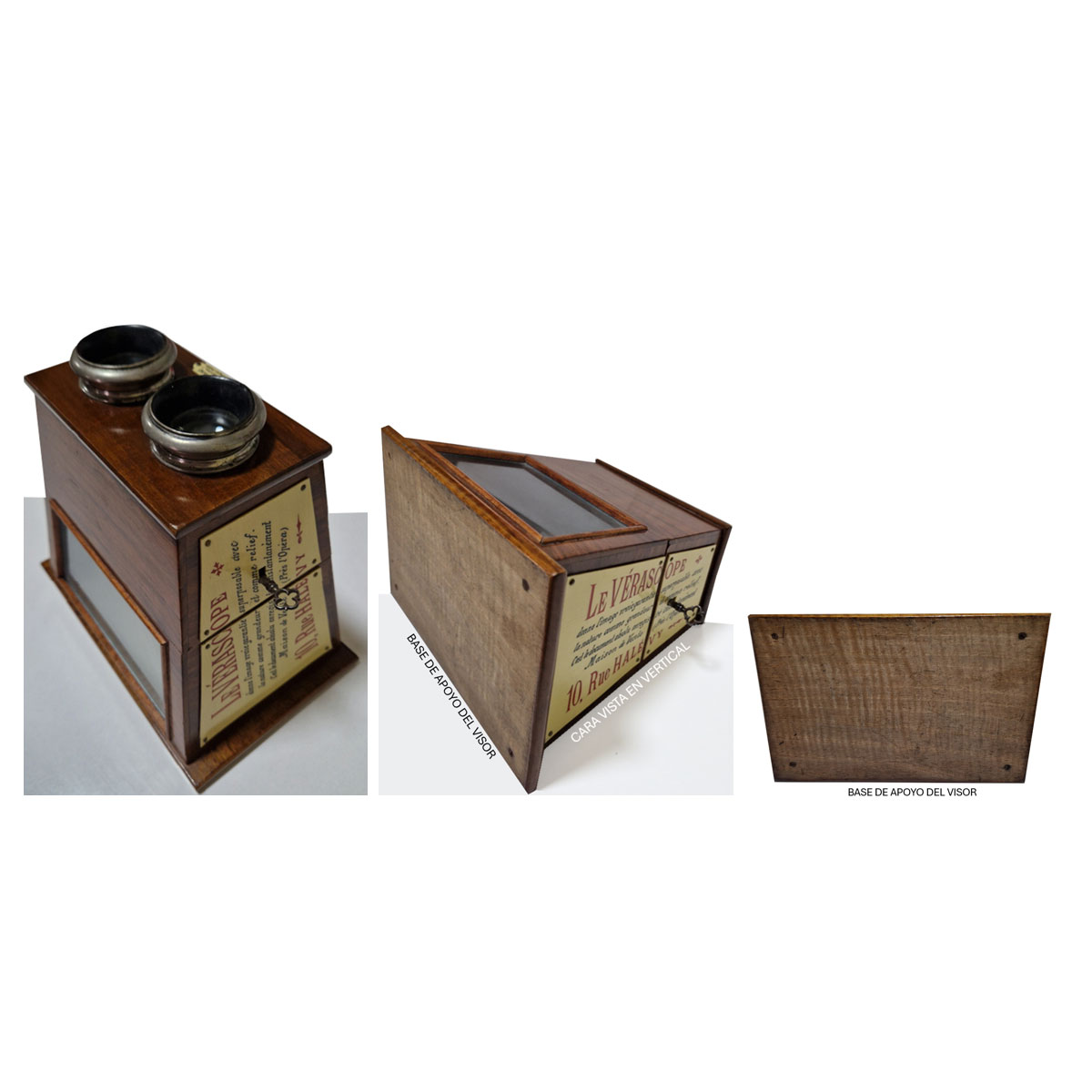
Recreation of the positions of The Vérascope scope when it was resting on the counter for customer use.
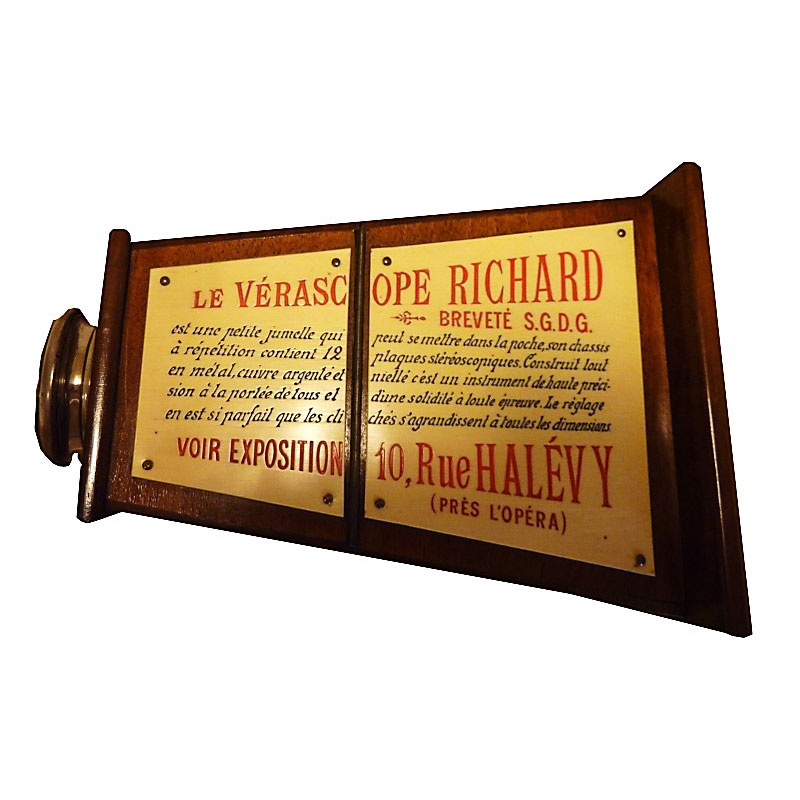
Side view of the scope, hinge area (hinge fitting). The Vérascope Richard advertising plate can be read.
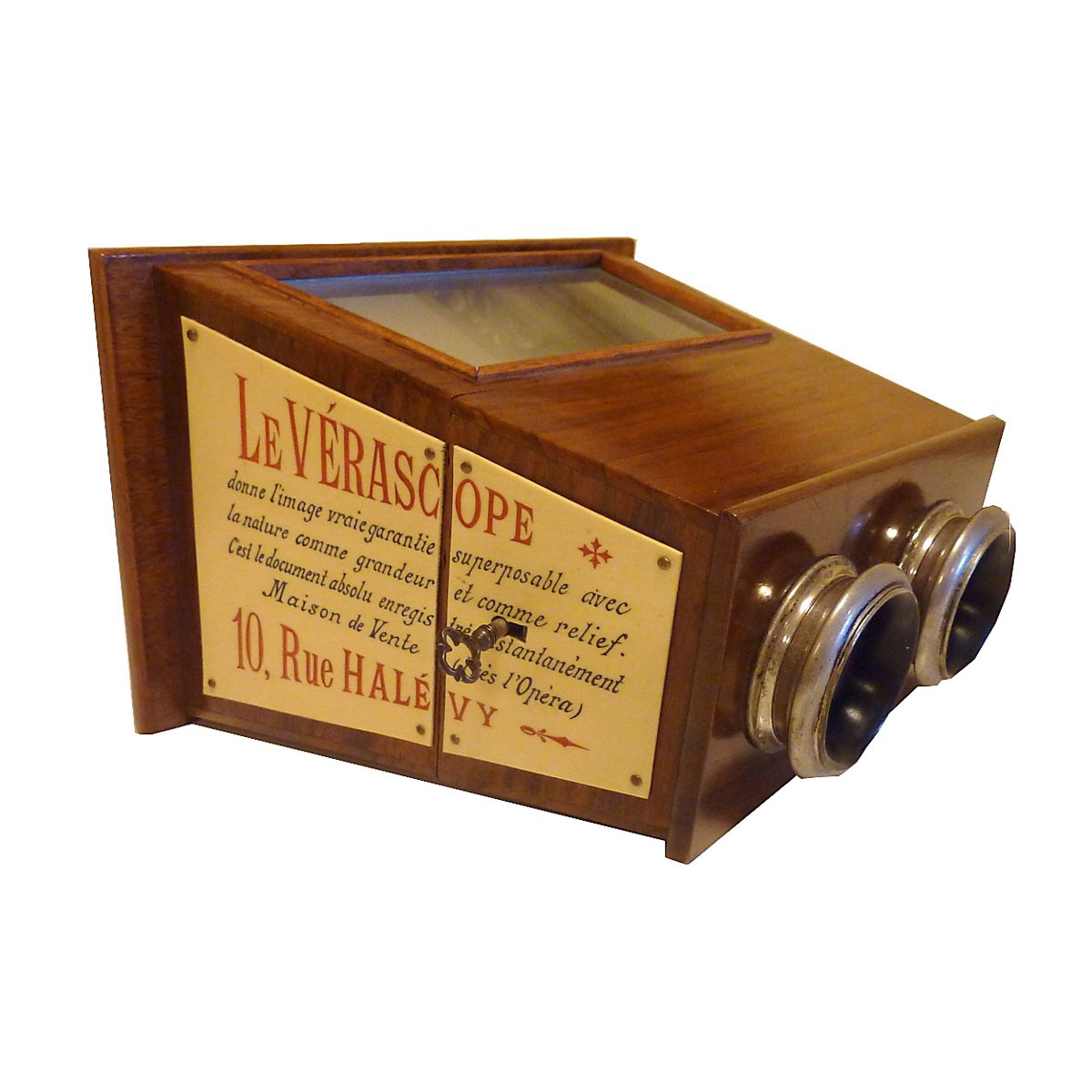
Side view of the viewfinder, opening area with lock. Another Vérascope advertising message can be read.
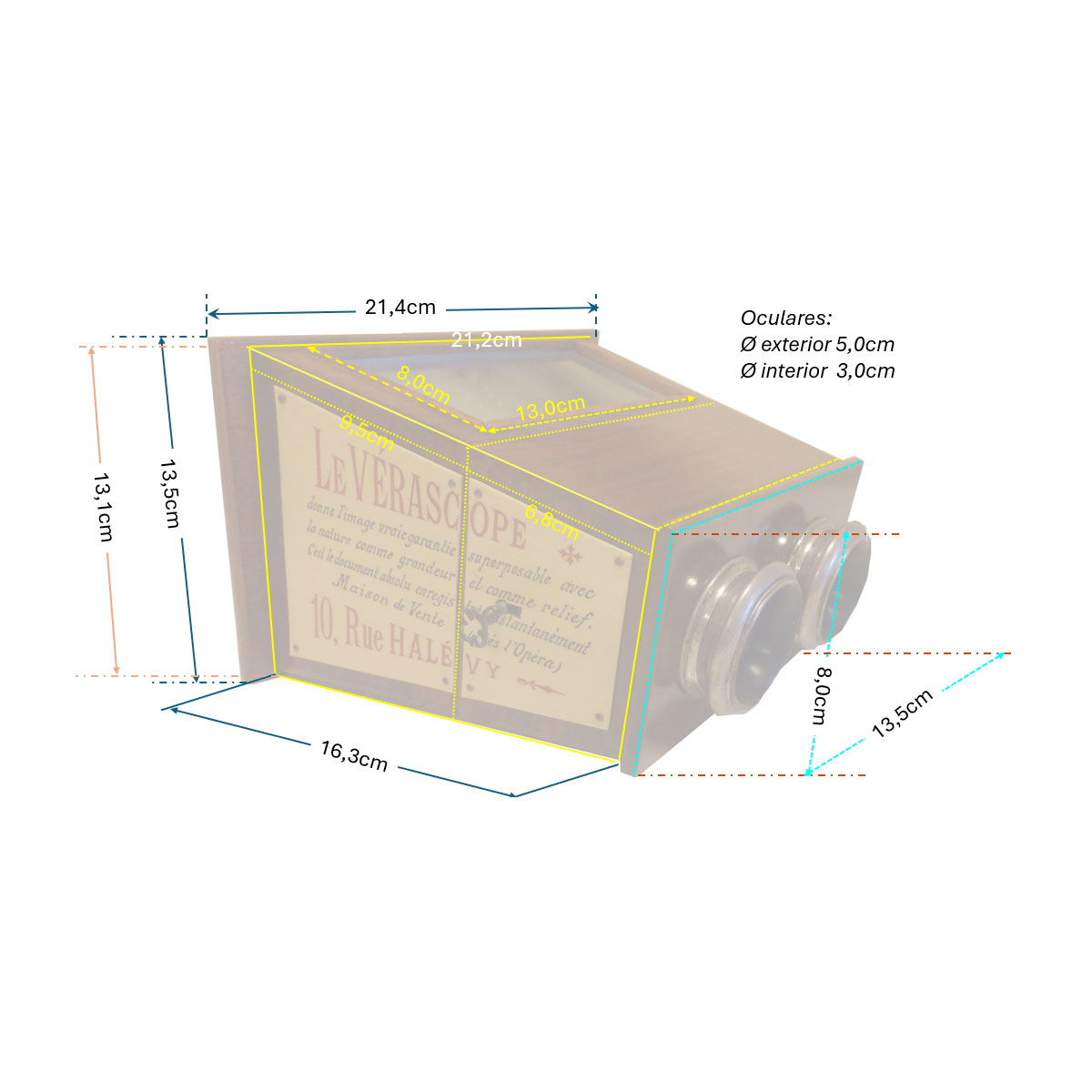
Overall dimensions
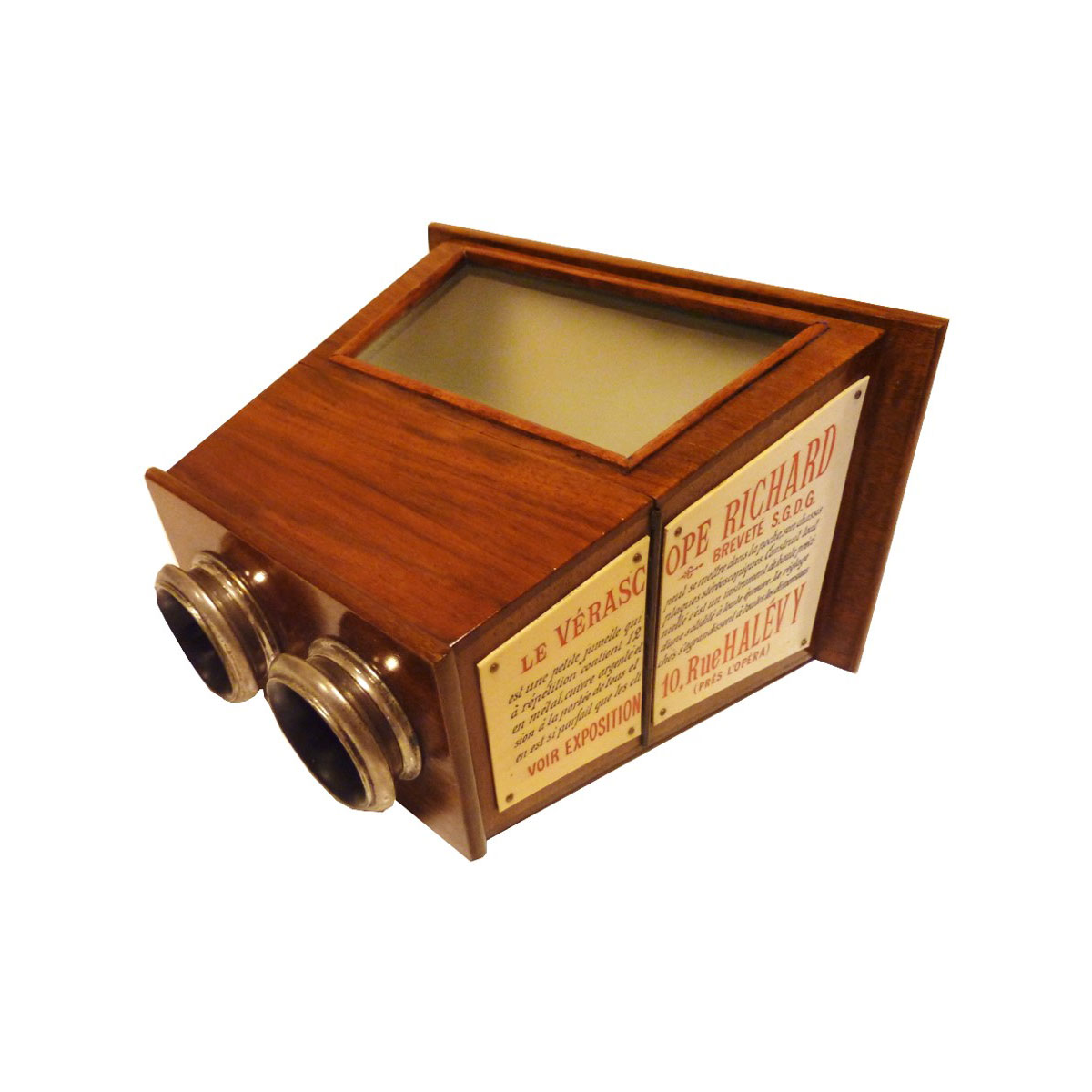
Let's look at the glass window of the lighting body and the reflection of the mirror.
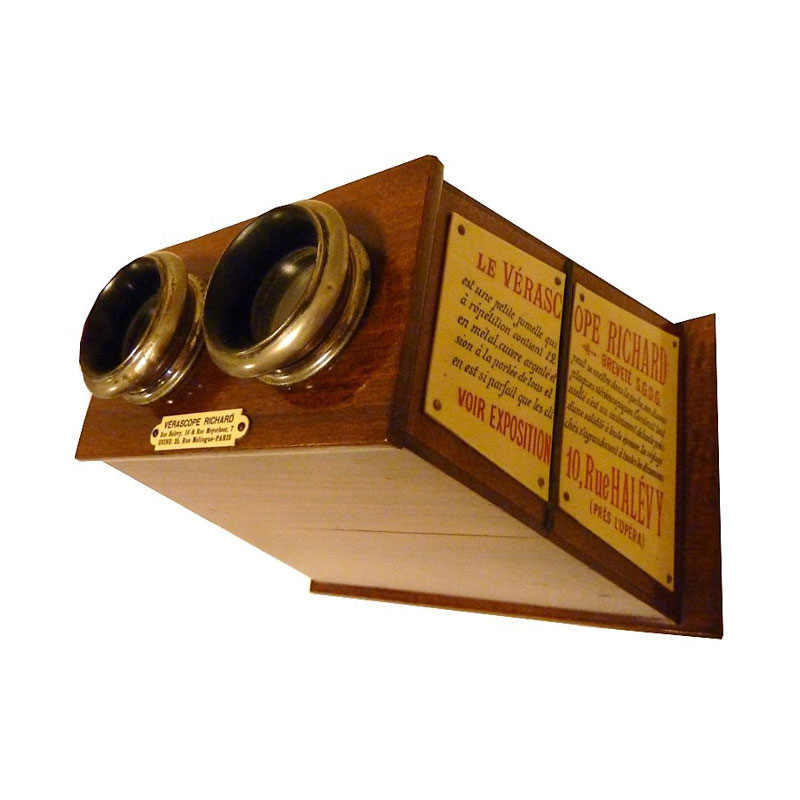
Upper body which is the viewing box/apparatus; view from the side of the joint.
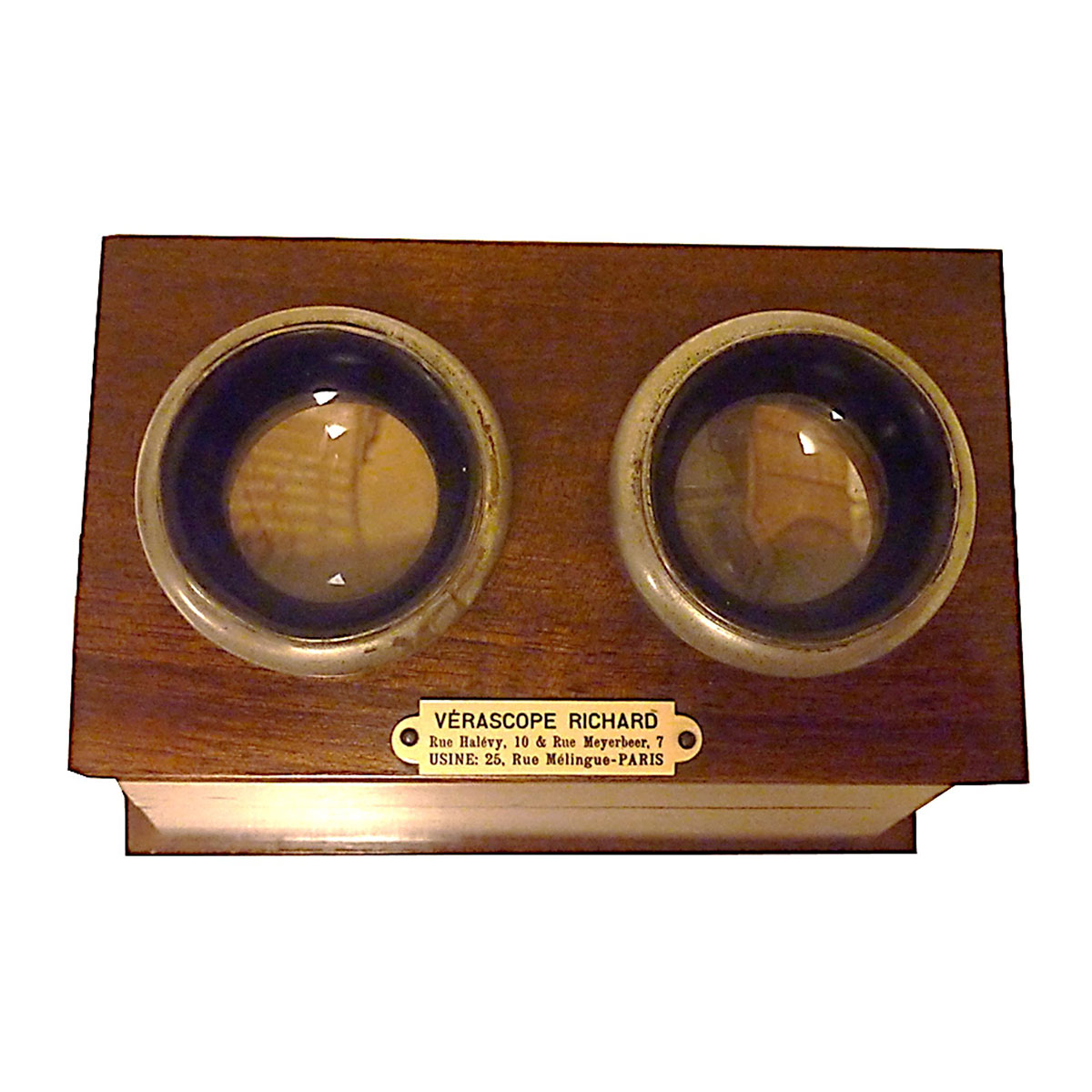
The eyepieces and their lenses closing the black box where the stereoscopy is housed.
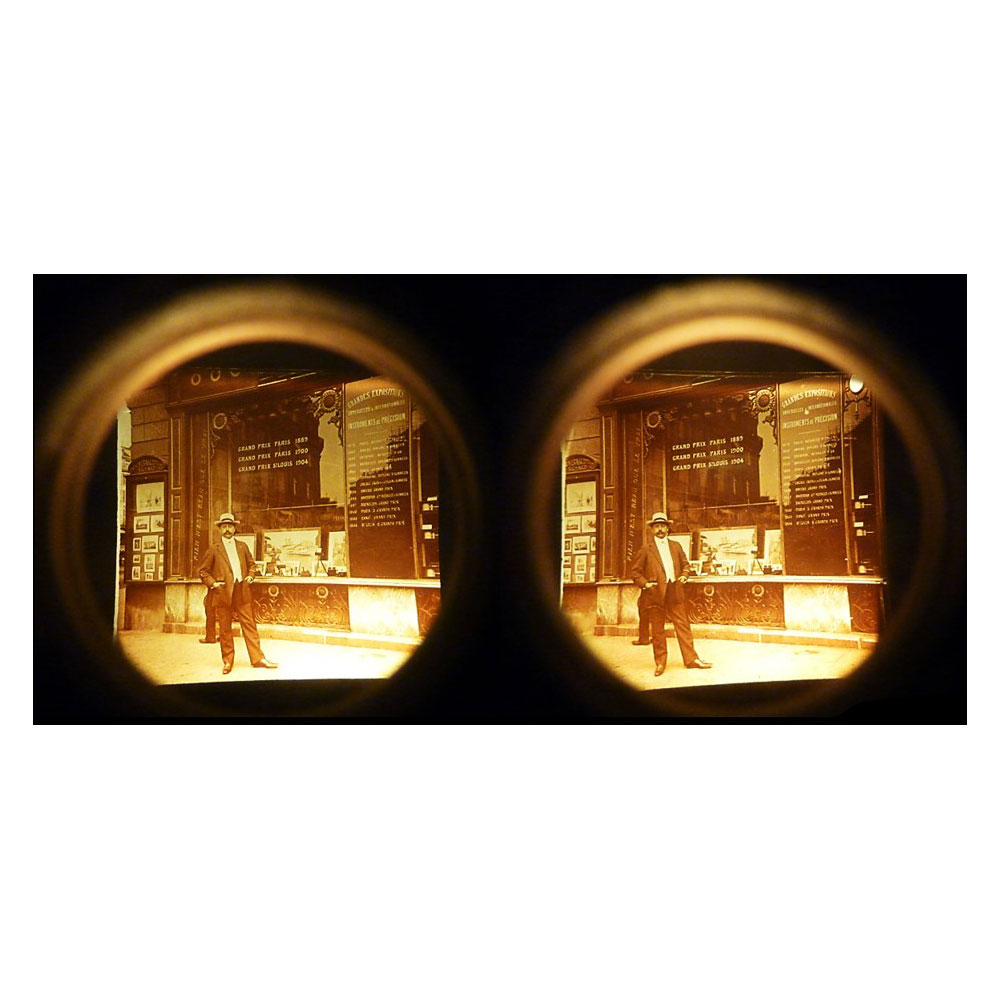
Approximation to the coulars to see the stereoscopic half pairs corresponding to the vision of each eye.
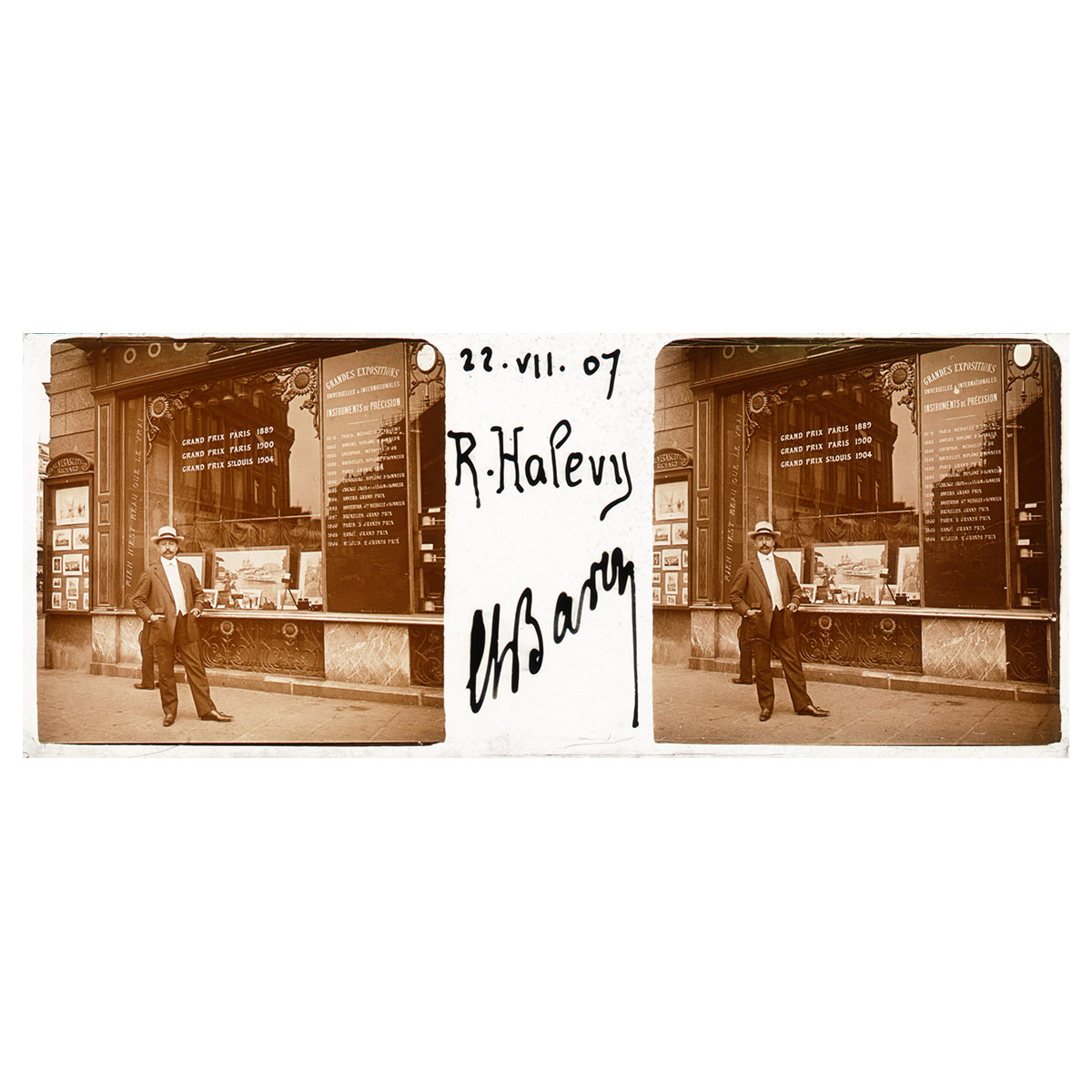
The stereoscopic 45x107 mm format dated 1907, with a character posing in front of the shop windows of the sales and exhibition office at 10 Rue Halevy.
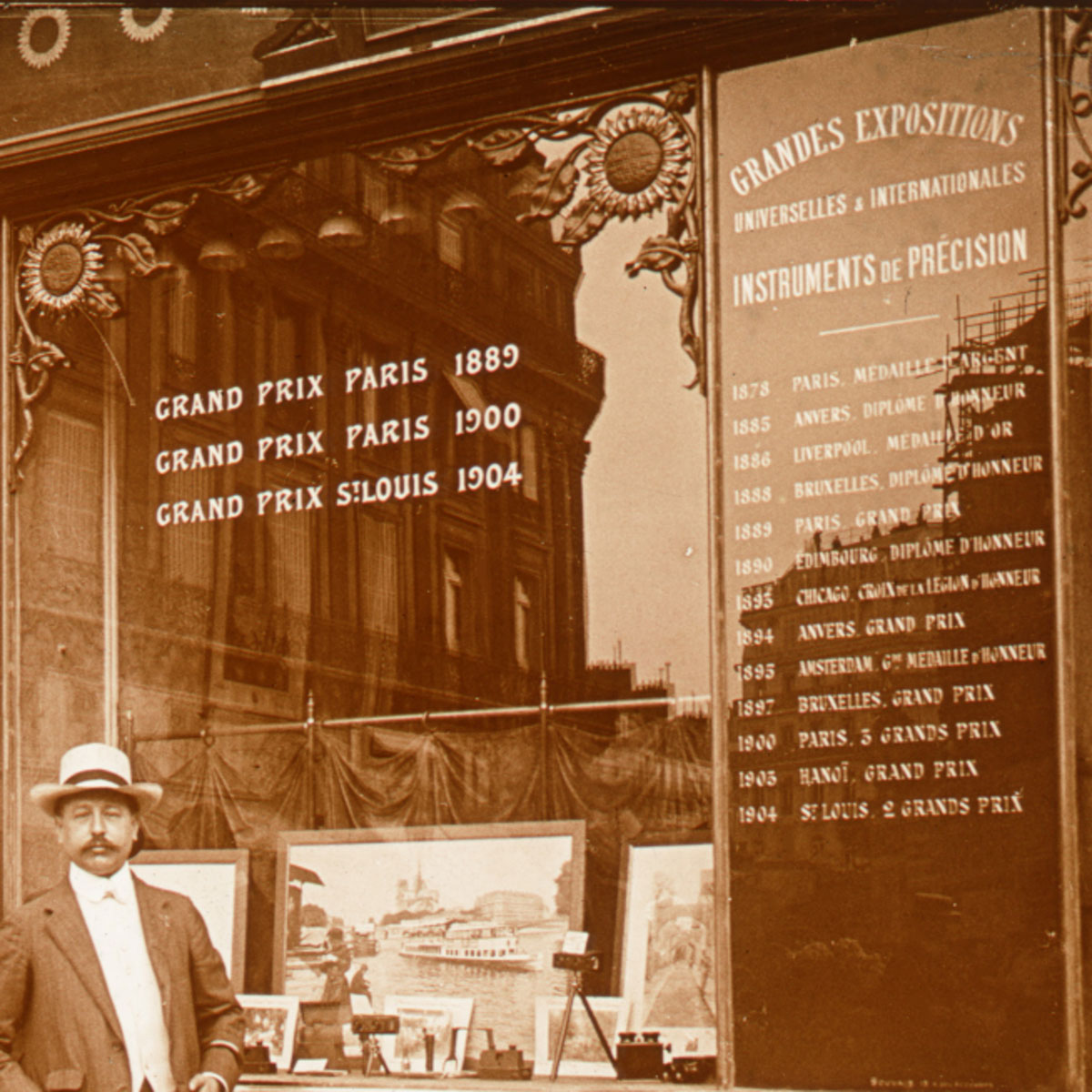
Clipping of half a pair with reviews of awards in Exhibitions.
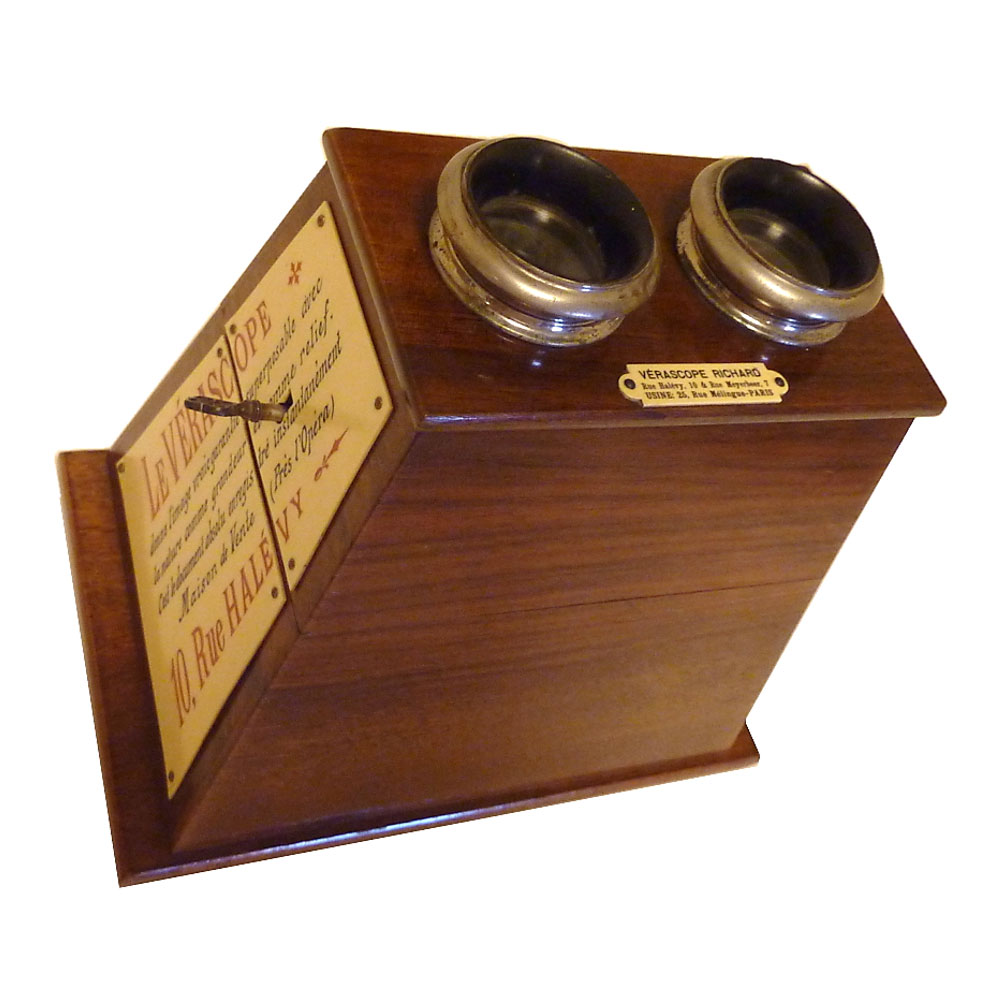
Start of the opening sequence of the two drawers: light and black box; from the lockable side.
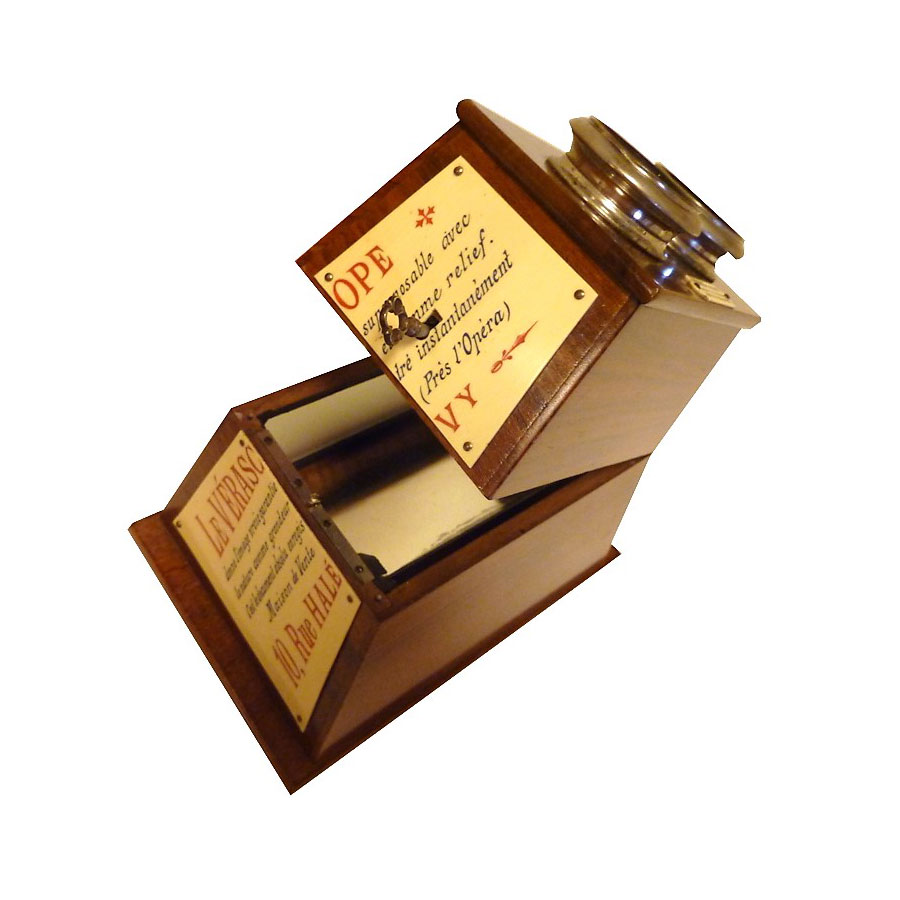
Opening with the key reveals the light box with its mirror.
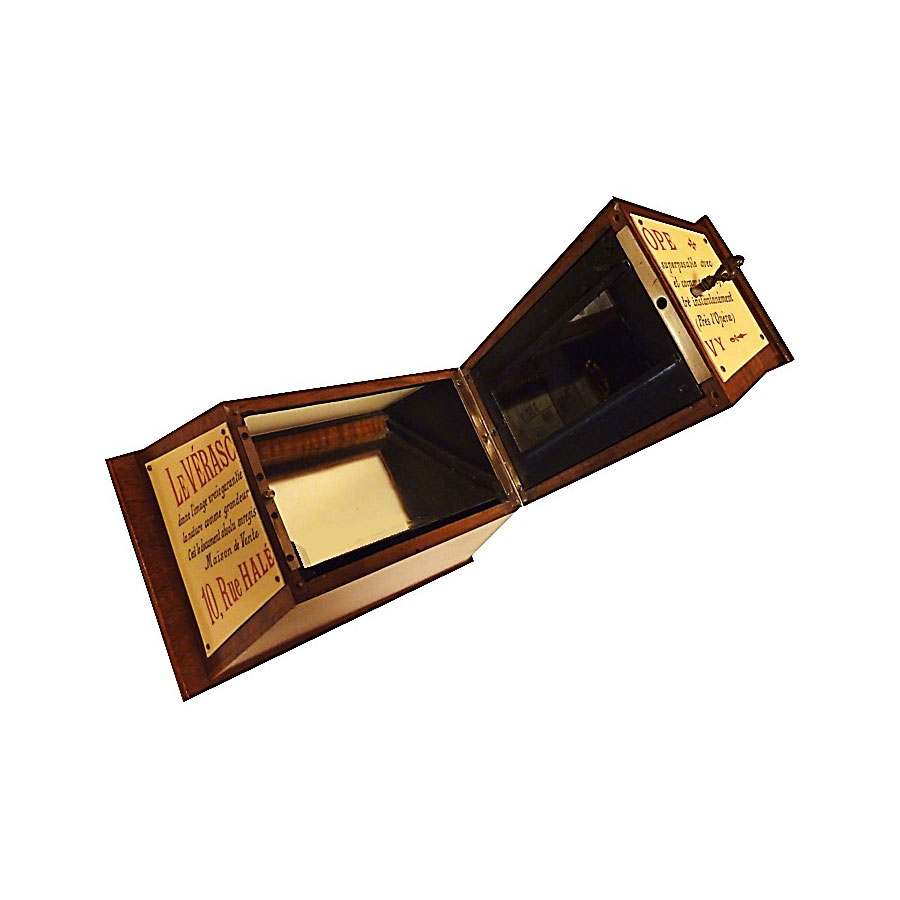
The full opening exposes the inside of the light box and the base of the black box with the guide to place the stereoscope.
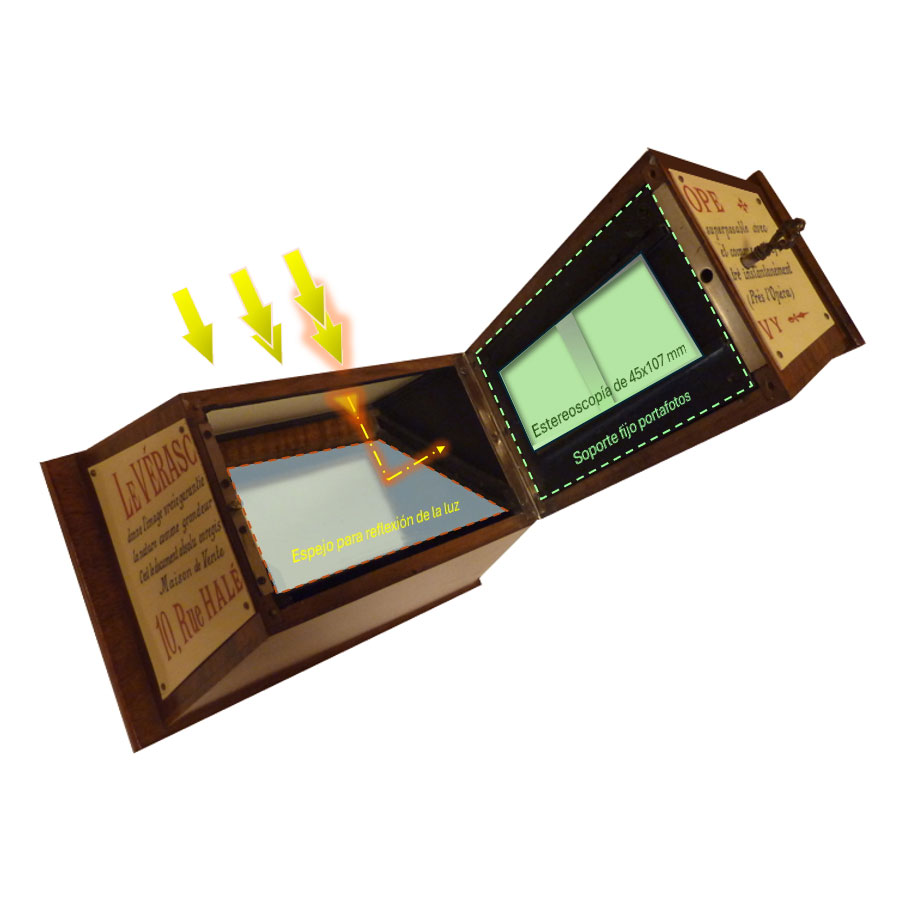
Lighting scheme
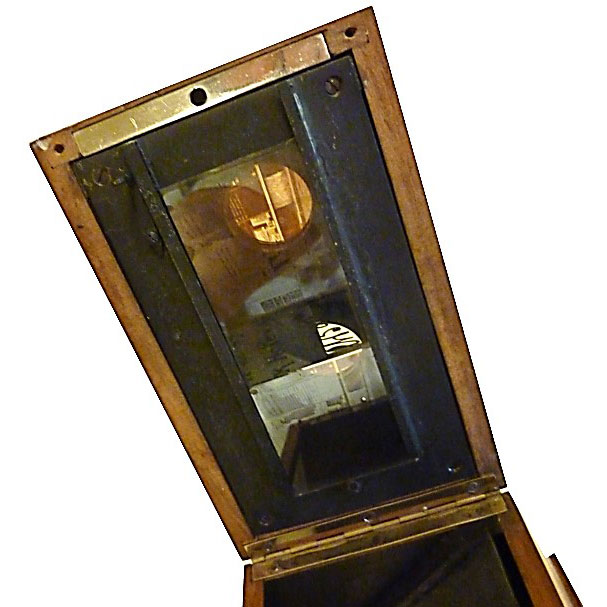
Detail of the base of the black box showing how the stereoscopy is positioned.
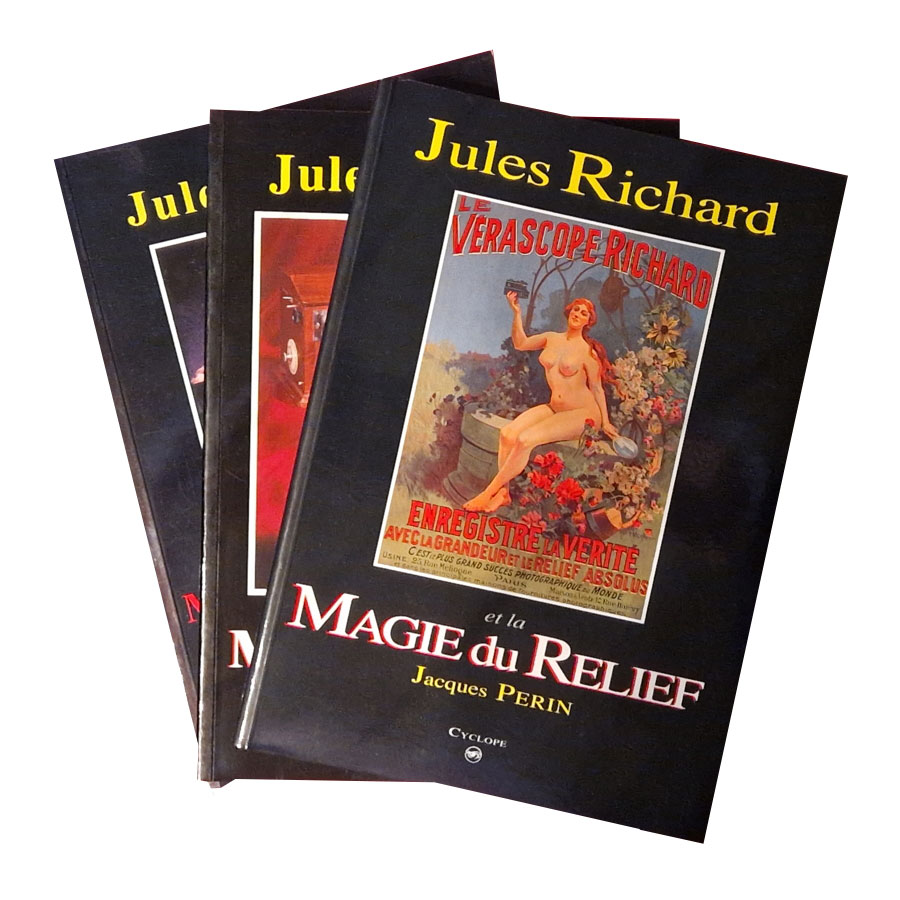
Trilogy by Jacques Perin, “Jules Richard et la Magie du Relief”, published in 1993, 1997 and 2001.
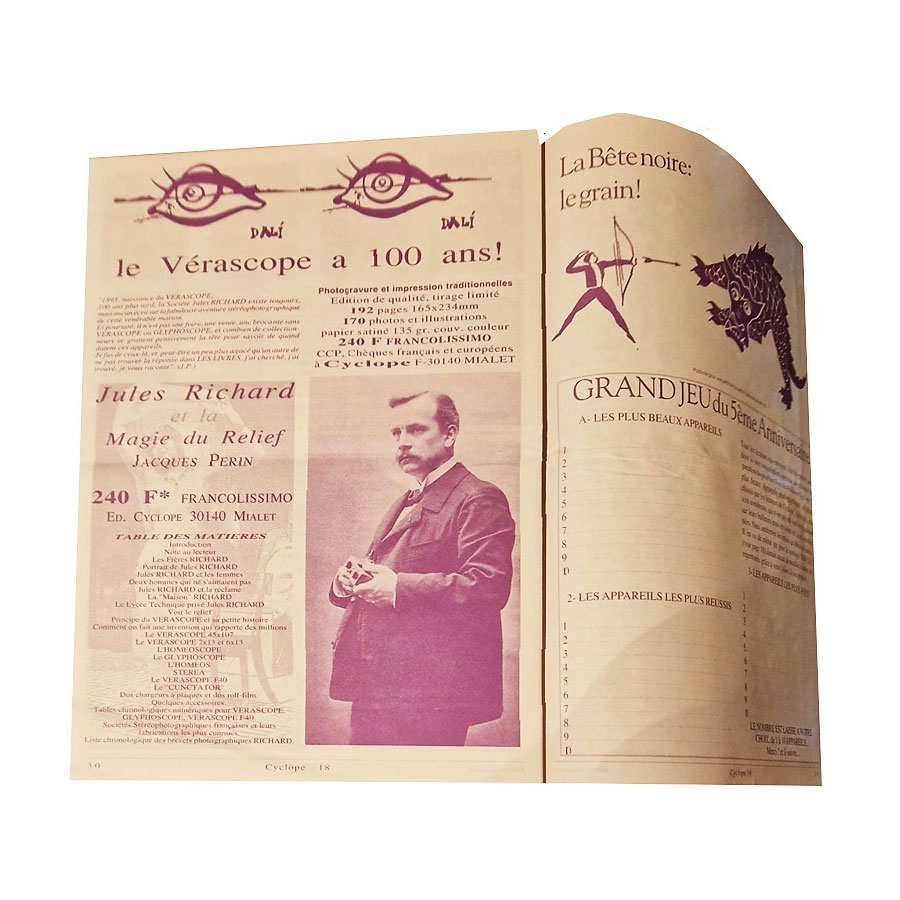
Article of the Cyclope Magazine Nº 18 page 30 dedicated (in offprint) to the 100 years of the Verascope.
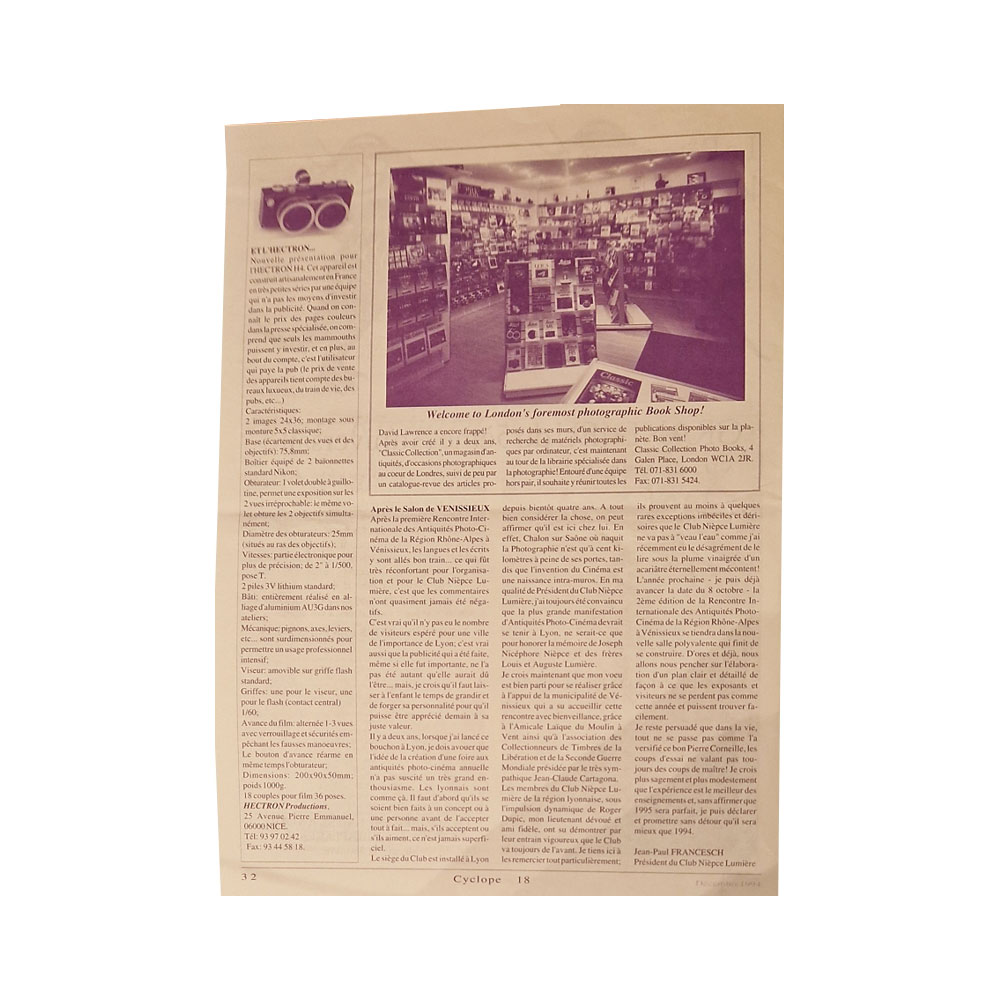
CLUB CYCLOPE offprint No. 18 - page 32
RESTITUTION DEVICES
STEREOSCOPIC VIEWERS FOR ADVERTISING
Production:
LE VÉRASCOPE by Jules Richard
with a fixed stereoscopy in 45×107 mm format.
In this month of May 2025 we have chosen a very singular piece from the FBS Collection, LE VÉRASCOPE VISOR, a model of hand-held stereoscope, with fixed focus (without focus adjustment and without eyepiece separator) which the engineer, photographer and industrialist Jules Nicolas Richard (1848-1930) placed in his distributors’ exhibition and sales establishments, announcing that his headquarters were at 10 Rue Hálevy in Paris in 1907.
Their uniqueness is pointed out by Jacques Perin in volume 3 of his trilogy dedicated to Jules Richard et la Magie du Relief. We translate from his text that: in the course of his research “he had the good fortune to discover two exceptional pieces whose rarity perfectly justifies this description”, noting that, although the design, of these two scopes, was not unique in the world, the purpose for which they were used and the extremely limited number of exemplars found made them particularly attractive.
Both were demonstration tools, but the target audience was different. One of them was intended to promote the Compagnie des Wagons-Lits, and therefore its distribution would be associated with places where tourism and the sleeping-car transport system could be promoted.
The other viewer is the one we see as the piece of the month of May/2025, in this case the potential audience was photographers and intermediaries in the sector. It was a direct demonstration that, to see quality stereoscopy, the best system was the Verascope. Jacques Perin explained that this stereoscope could only be found in Jules Richard’s shops or in his dealerships, placed on the sales counter and available to the future stereoscopist.
This LE VÉRASCOPE advertising and demonstration visor is made of mahogany wood. It is similar to the Brewster model, but with straight lines and large dimensions. Its body is divided into two parts:
From the support base, made of treated wood, to the central opening (9.5 cm) we have a first hollow box (tinted black) which acts as a light chamber, as it is fitted with a window with frosted glass in the upper part; inside it, and forming a 45º angle with the upper line of the window, we find a mirror on which the light rays fall, which are directed to the lower face of the second body, where the stereoscopic glass is fixedly positioned.
From the middle opening to the tablet with the eyepieces, the second hollow box (painted black) is extended, the length of which is 6.8cm. On the side opposite to the lenses there is a frame (also painted black) with guides to hold a stereoscopic glass of 45×107 mm format.
There is no mechanism to allow adjustments, or any other type of manipulation, to the elements that make up the viewer; unless you want to put a different stereoscopic view to replace the one in the base of the second compartment.
The 45x107mm stereoscopic view contained in the viewer when it was acquired for the FBS Collection, shows the façade of the shop at 10 Rue Halévy, in the 9th arrondissement of Paris. Calligraphically identified in the central area between the pairs, it is dated 1907; the person posing in front of the camera is not fully identified, although it was initially thought to be Jules Richard himself.
There is no doubt that the image shows the shop windows of the VERASCOPE RICHARD establishment, above whose sign in large letters, but in a different and smaller typeface, another sign read: ANCIENNE MAISON RICHARD FRÈRES. The latter was the family company inherited from Félix Richard (father 1809-1876), by two of the four sons from his marriage to Françoise Antoinette Froment (1821-1912) in 1843: Antoine Albert (1845-1912), Jules Nicolas (1848-1930), Félix Maxime (“Max”, 1856-1949) and Georges (1863-1922).
Specifically, the heirs were Jules and Max, who continued to manufacture and improve barometers and other measuring instruments after their father’s death in 1876, but the company was somewhat abruptly dissolved in 1891.
The artistic, technical and scientific mentality of the four Richard brothers allowed them to follow different paths, which often complemented each other, and which led to the creation of automobile companies, photography shops, developments in cinematography, industries and schools, which today we would call vocational training.
All this creativity and entrepreneurial drive came from both their father’s and mother’s sides of the family, as their mother was the sister of Paul-Gustave Froment (1815-1865), a French mechanic, instrumentalist and inventor, to whom a photograph on paper dated 1835 is attributed, four years before Daguerre and the French Academy announced the invention of the daguerreotype in 1839.
These genes and the Richard brothers’ ability to develop their potential, contrast with the stubbornness we see in people determined to make of themselves inventors from scratch. If we look at the case of the Richards, focusing on Jules, we see their patents and technology constantly being perfected to manufacture camera equipment, viewers and all their accessories, under the VÉRASCOPE RICHARD and HOMEOS brands, among others of their production.
The quality of the product was recognised from the very moment his products began to be marketed, after dedicating part of the original factory in Rue Melingue (Paris) to the manufacture of stereoscopic cameras and viewers under the brand name VÉRASCOPE, in 1893. In fact, in Spain, the Veráscopo built and patented by Jules Richard was advertised in the catalogue of Casa Salvi (founded in 1887 – with sales at 12-14 Sevilla Street in Madrid), as the high precision photographic apparatus with a real guarantee and practical for everybody. Salvi was also a stereoscopic photographer, and he represented many other manufacturers, such as Carl Zeiss, Goerz, R. Talbot, etc. However, he echoed Richard’s singularity by applying the laws of optical reversibility to his products, which was apparently a new idea, as he obtained absolute relief and perspective. This catalogue, published in 1904, dedicated pages 58 to 63 to this innovation.
The same catalogue also included other Richard products such as the Richard Taxiphotes automatic sorting stereoscopes.
A table stereoscope that automatically classified the views and indicated the place in the storage tray they occupied was, in practice, a scientific mechanism that Jules applied as a consequence of the teachings received from his teachers. In the first stage of his apprenticeship (between the ages of 15 and 18) with the watchmaker Émile Colin, then with Étienne Jules Marey (1830-1904) between the ages of 19 and 22, before taking over the family business.
The political difficulties in Europe, and in France in particular, make us look back to the period when Jules Richard took his first steps in his acquisition of knowledge, apart from the knowledge he might have drawn from his family environment.
His birth, on 19 December 1848, coincided with the election of Louis Napoléon Bonaparte as President of the Second French Republic (20 Dec. 1848 to 02 Dec. 1852). During his childhood, he lived through the coup d’état he staged on 02 Dec. 1851 and the proclamation of the Second Empire with the enthronement of Napoleon III (1852 to 1870) as Emperor, which covered his entire adolescence and even his early youth (from 5 to 22 years of age). At the age of 22-23 he lived through the Franco-Prussian War (19 Feb. 1870 to May 1871) and the end of the French Empire. At the age of 23, we find him precisely at the beginning of the Third Republic (04 Sept. 1871); meanwhile also experiencing something as significant and moving (in images) as the almost three months of the development and decline of the Paris Commune (18 Mar. to 28 May 1871). All these events must have marked the following years of Jules Richard and his contemporaries, including Carl Zeiss.
Several generations lived through these stages of history and, among the following vicissitudes, experienced the situations before and after World War I or what has come to be known as the Great War (1914-1918). Jules Richard reached this phase of history at the age of 66, and his social participation in these tragic years was active and constructive. He died in 1930, at the age of 81, after having set up sales and display centres, as well as factories and workshops in which he made his assembly lines for the stereoscopic photography sector, which was also included in the Jules Richard Foundation (founded on 16 July. 1923). He combined science, technique and practice; he devoted his time to the pursuit of the highest quality.
To learn more:
- E.J.Marey, La Machine Animale, locomotion terrestre et aérienne, Librairie Germer Baillière, Paris 1973.
- Braulio López y Compañía , Aparatos y Artículos para la Fotografía, calle Príncipe 27 de Madrid, 1903 (aviso de supresión de la palabra Compañía a partir del 1º de Junio).Imprenta de Jose Poveda, Segunda Parte Aparatos fotográficos, Verascope Richard pág 31 a 35, Cuarta Parte Accesorios, Ampliadoras Richard pág 60, Linterna Richard y proyección de positivas del Verascope popr medio del Taxiphote pág 64-65, Estereoscopios a mano para Veráscope pág. 78-79, Taxiphotes Richard pág. 80.
- Carlos Salvi, Catálogo General, Artículos para la Fotografía. Instrumentos musicales mecánicos, calle Sevilla 12-14 de Madrid, 1904. Imprenta de Hijos de M.G. Hernández, pág 53 a 64, Veráscopo.
- Braulio López, Aparatos y Artículos para la Fotografíay Cinematógrafos, calle Príncipe 27 de Madrid, 1905.Imprenta de Jose Poveda, Segunda Parte Aparatos fotográficos, Verascope Richard pág 39 a 41, Cuarta Parte Accesorios, Ampliadoras Richard pág 71, Estereoscopios para Veráscope pág. 95 a 98,
- Etablissements Jules RICHARD, S.A. Centenaire Jules Richard, 1855-1955 Cent ans au service de l´Industrie, 25, Rue Mélingue – París-19e
- Jacques Perin, Jules Richard et la Magie du Relief, Copyright Jacques Perin et Cyclope 1993, págs. 36 a 40.
- Jacques Perin, Jules Richard et la Magie du Relief, tome 2, Copyright Jacques Perin – Prodiex 1997.
- Jacques Perin, Jules Richard et la Magie du Relief, tome 3, Copyright Jacques Perin – Prodiex 2001. Rares Visionneuses págs. 14-15 y 41 a 46.
- François Boisjoly, Répertoire des Photographers – de XIXE siècle, París, Les Editions de l´Amateur, 2009, pág. 247 – Richard, Jules (debut d´activité1888).