
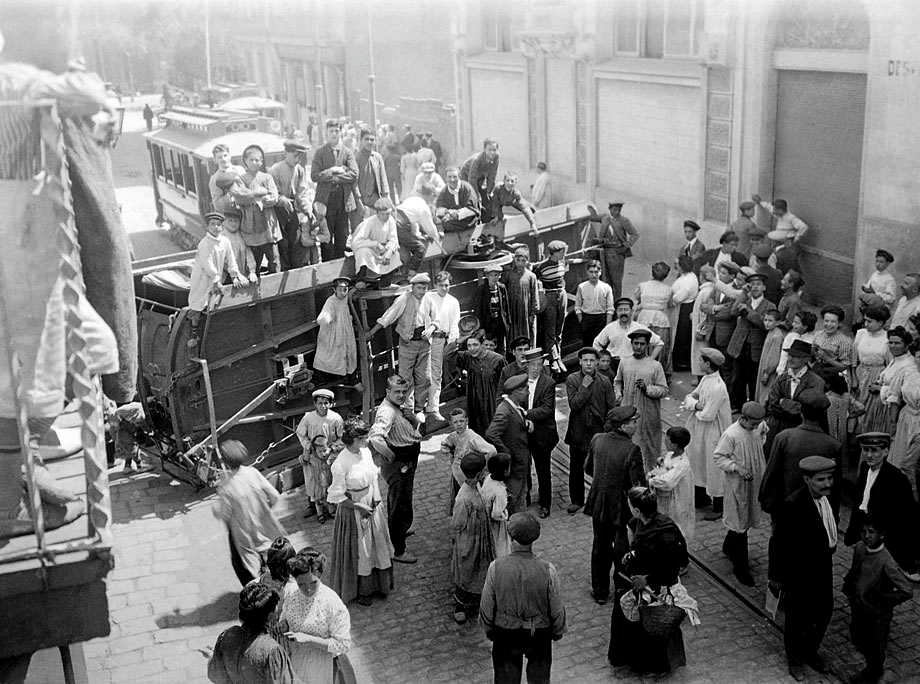
Barricade with tram in the Gràcia neighborhood during the Tragic Week of Barcelona, July 1909. Photograph attributed to Josep Brangulí. Arxiu Nacional de Catalunya.
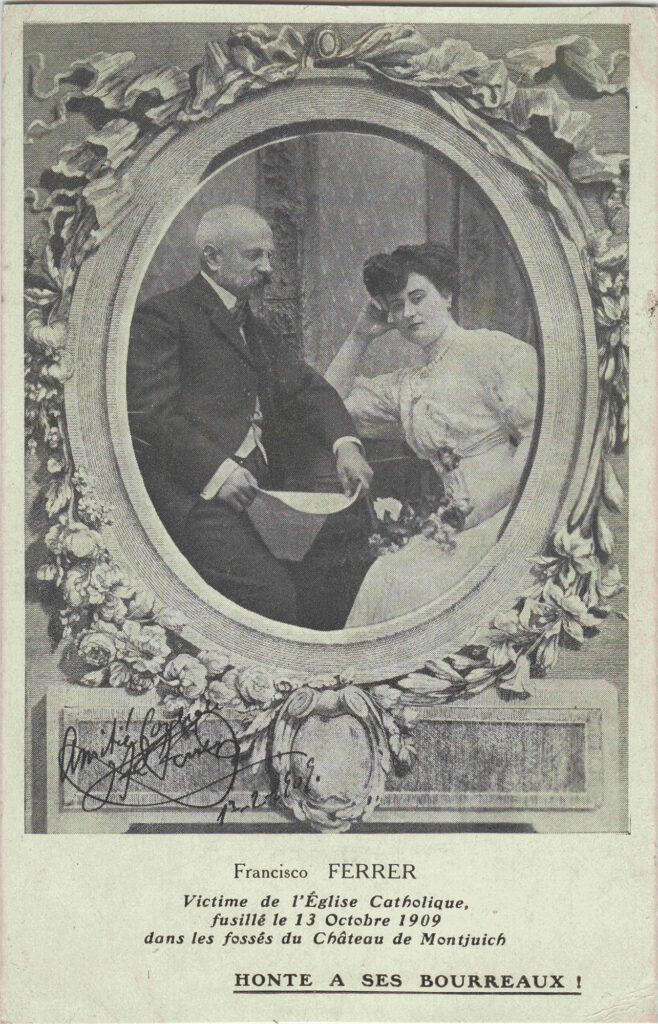
Postcard published by Édition du Libertaire (Paris) The image shows Francisco Ferrer accompanied by Soledad Villafranca. The postcard includes the following text in French, translated as: Francisco FERRER Victim of the Catholic Church, Executed on October 13, 1909, in the moats of Montjuïc Castle. Shame on his executioners! FBS Foundation Collection
At the beginning of the 20th century, the Spanish State launched military campaigns in North Africa, driven by colonial and economic interests. The Gurugú War (1909) was one such campaign: an offensive aimed at securing control of the Rif mines, presented to the public as a patriotic mission.
Thousands of young men, mostly from working-class families, were sent to fight and die in a land they did not know, without fully understanding the reasons behind a war on foreign soil. Meanwhile, those with resources could avoid military service, placing the burden of the conflict on the most disadvantaged sectors.
The occupation of Mount Gurugú was accompanied by an intense visual propaganda campaign. Photographers such as José Demaría López “Campúa” and Alfonso Sánchez García, known as Alfonso, disseminated images of battles, corpses, executions, and troop arrivals in illustrated magazines like Nuevo Mundo and in the series El Álbum de la Guerra de Melilla[1], among others. These photographs were not neutral: they constructed a narrative of heroism against a supposed barbaric enemy, concealing the invasive nature of the Spanish army and silencing the plundering of resources.
In Catalonia, opposition to forced conscription led to a popular uprising known as the Tragic Week of Barcelona. During several days in July 1909, closed factories, barricades, and clashes with the army reflected the deep unrest of the working class. The State’s response was ruthless: martial law was declared, troops were deployed, and the civilian population was harshly repressed. There were over a hundred deaths, hundreds of arrests, and five death sentences, including that of the educator and freethinker Francesc Ferrer i Guàrdia, who was executed.
Ferrer was a Catalan teacher who founded the Modern School in 1901, a secular and free educational project where teaching was done without religion or punishment. His goal was to embrace the aspirations of the Free Institution of Education and to form critical individuals capable of thinking for themselves, at a time when education was dominated by the Church.
His execution, after a trial considered a farce, sparked protests around the world. Among those who raised their voices were Nobel Prize winners such as Anatole France, George Bernard Shaw, and Romain Rolland[2]. Ferrer became an international symbol of the struggle for freedom of thought. Postcards like the one preserved in the FBS Foundation archives were part of that global outcry. A commemorative medallion is also part of this collection.
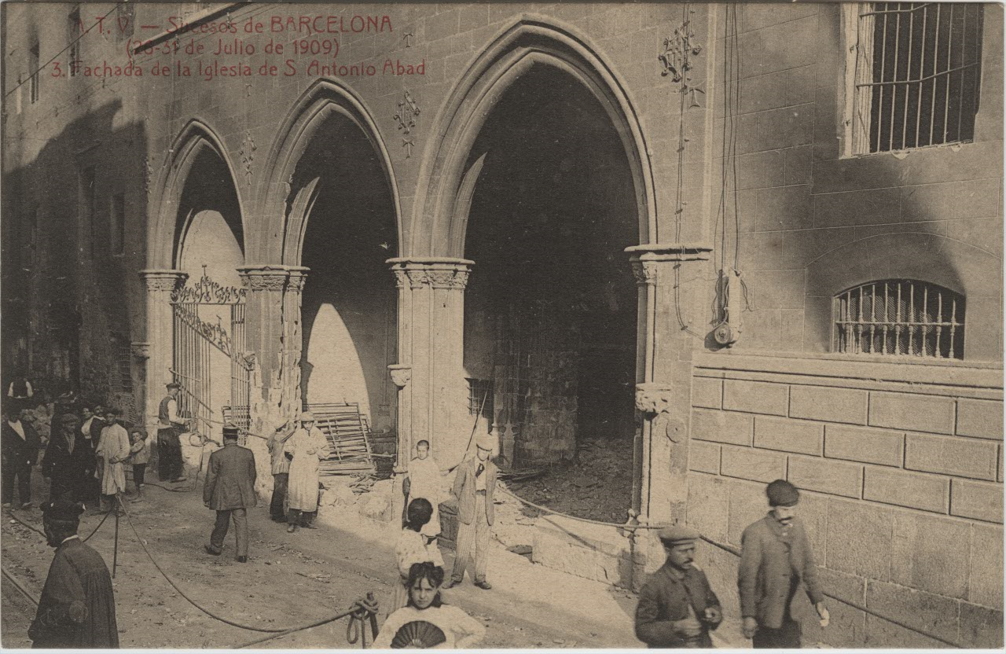
Façade of the Church of Saint Anthony Abbot, phototype. Ángel Toldrà i Viazo Editions, Barcelona, 1909. FBS Foundation Collection
The postcard, published by Édition du Libertaire, in Paris, contains the following text, translated from French:
Francisco FERRER
Victim of the Catholic Church,
Executed on October 13, 1909
in the moats of Montjuich Castle
Shame on his executioners!
The uprising was also an explosion of anticlericalism. The burning of convents and religious schools expressed popular rejection of the alliance between the Church and military power. For many, the clergy symbolized complicity with a system that sent the working class to die in colonial wars. The protest was not only against the war, but against a structure that legitimized inequality from the pulpit.
In this context, photography does not merely document: it constructs a narrative. A narrative that avoids any reflection on the deeper causes of the conflict and numbs society’s critical consciousness. Reviewing these images today requires a careful gaze that questions their function, context, and legacy.
The FBS Foundation archives preserve a valuable collection of 100 postcards documenting the effects of the Tragic Week. The postcards, printed using phototypy, were published by Ángel Toldrà i Viazo (Barcelona, 1867–1956). They show the devastation caused by the burning of convents, churches, religious schools, and other buildings linked to the Church, within the framework of an uprising that combined opposition to forced conscription with a deep anticlerical sentiment.
Far from being mere visual documents, these postcards are part of a representational strategy that oscillated between denunciation, sensationalism, and propaganda. Many were produced by commercial studios that saw the conflict as a business opportunity, while others circulated as graphic testimony.
Juantxo Egaña
[1] Sanchez Vigil, Juan Miguel. Photography in the African Wars (1859–1927). Fragua Publishing. Madrid, 2021
[2] Rocker, Rudolf. In the Storm (Years of Exile). Tupac Publishing. Buenos Aires, 1949.