
Since its beginnings, photography has established itself as a powerful tool for the documentation of war conflicts, allowing not only to portray them, but also to influence how they are remembered for posterity.
Since its inception, there are references to its use in wartime contexts. According to letters published by his great-grandson, John F. Schwartz, during the Mexican-American War (1846-1847), the American soldier William Philip Schwartz used his camera to capture some daguerreotypes.
On 1 July 1848, the magazine L’Illustration, journal universel, reproduced, in the form of an engraving, two daguerreotypes signed by M. Thibault of a barricade during the 1848 revolution in Paris. These daguerreotypes are now in the Musée d’Orsay in Paris.
Photography in its consolidation: The Paris Universal Exhibition of 1855
Photography began to establish itself as an artistic and documentary medium of great importance in the 19th century. A turning point in its history was the Paris Universal Exhibition of 1855, where this art form played a prominent role. Among the pioneers of photography was Carol Popp Szathmari (1812-1887), a Romanian photographer who presented an album on the Crimean War. His collection, which captured images of Russian and Turkish soldiers, earned him a medal of recognition and positioned him as one of the first to capture a conflict through this innovative medium.
The catalogue of the Universal Exposition, published by Hachette et Cie., highlighted the landscape and monument images of two English photographers: Maxwell-Lyte (1828-1906) and Roger Fenton (1819-1869). The latter had also documented the Crimean War. Thanks to his extensive work, Fenton is considered one of the first war photographers. His images, however, presented an idealised view of the conflict, often limited to posed portraits of soldiers or scenes that omitted the brutality and misery of the fighting. It is important to mention Richard Nicklin, another British photographer who was in the Crimea. Sadly, all his images were lost in the wreck of the ship on which he was returning to England, in which he also lost his life.
Despite their limited scope, the Crimean photographs were landmark in capturing faces and moments of history, although they did not reflect the rawness of the war. Some of these images were reproduced as prints in The Illustrated London News magazine that same year.
A leap into rawness: the American Civil War
Photography took a step forward in the representation of war during the Civil War in the United States. In this conflict, the images of Alexander Gardner (1821-1882), Timothy H. O’Sullivan (1840-1882) and Thomas C. Roche (1826-1895) captured more powerful and realistic scenes. Gardner’s photographs at Antietam (1862) and O’Sullivan’s photographs at Gettysburg (1863) showed the horrors of the battlefield and, for the first time, the human consequences of war. On the other hand, Roche’s images, such as those of the trench in Fredericksburg, Virginia, added a raw and inescapable dimension.
An emblematic example of this transformation came with the Gettysburg photographs, which were subsequently published as engravings in Harper’s Weekly magazine, issue 447, on 22 July 1865. These images marked a shift in the visual narrative of the war, showing the devastation and human cost of the engagement, something that had hitherto not been recorded with such impact.
After the end of the American Civil War, in May 1866, the Courret brothers of French descent captured images of the defence of the port of Callao in Peru during the bombardment by the Spanish Navy.
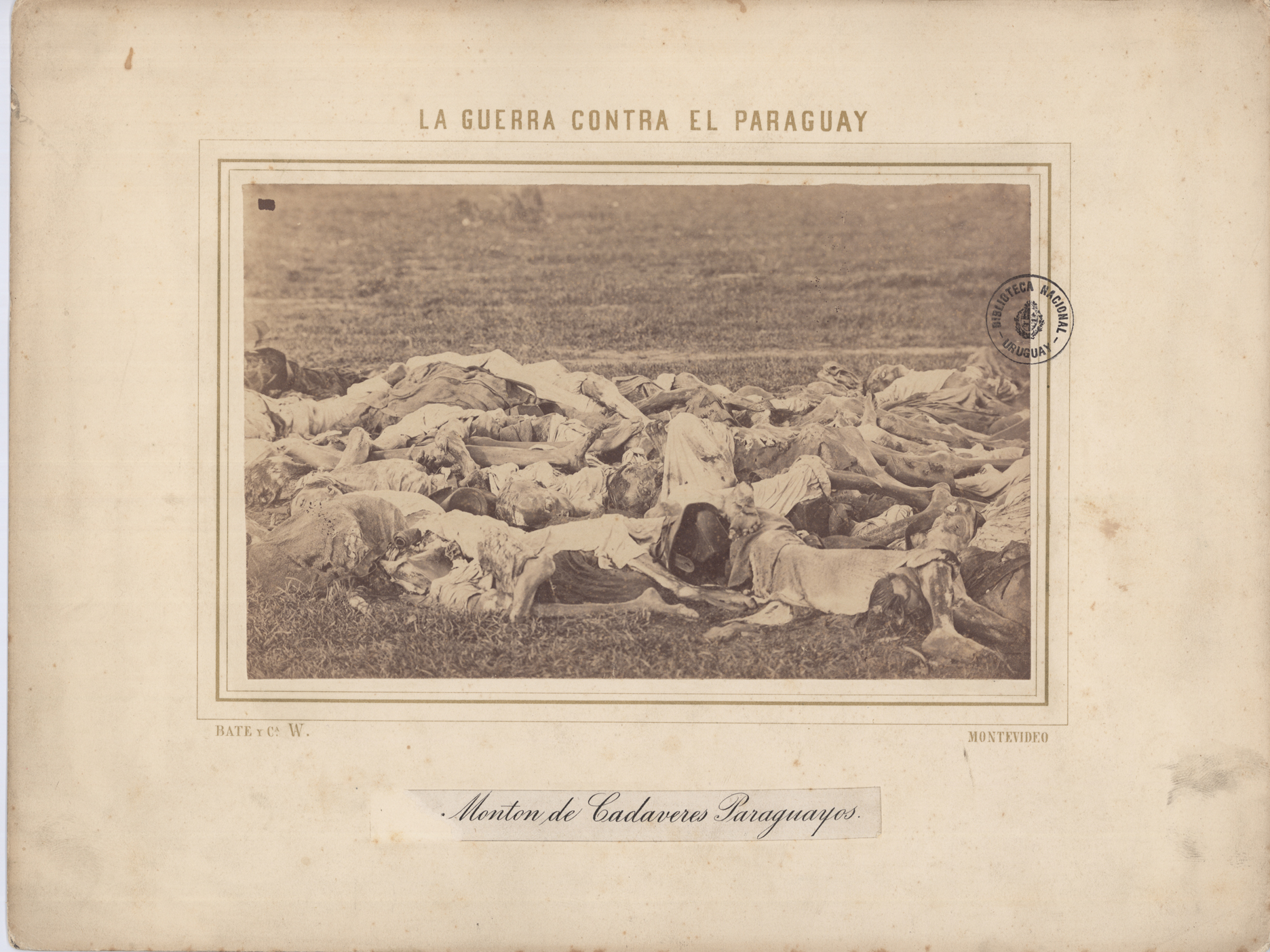
The war against Paraguay. Pile of Paraguayan corpses. 1866.
Photograph by Bate & Cía. National Library of Uruguay.
In the course of 1866, the War of the Triple Alliance, also known as the Paraguayan War, not only left a deep mark on the history of these countries, but was also recorded for posterity thanks to the work of the firm of Bate & Cía created by the North American photographer George Thomas Bate. The photographs captured by members of this photographic group, Javier López, Esteban García, José Murature and George Thomas Bate, which are now kept in the National Library of Uruguay, not only document battlefield scenes, but also include portraits of soldiers and officers who took part in the war. Many of these portraits, presented in carte-de-visite format, offer an intimate look at the protagonists of the conflict. Among the most striking images are those that reflect the brutality and consequences of war. Some of these photographs show battlefields littered with corpses, demonstrating the rawness and human cost of the fighting.
The Franco-Prussian War (1870-1871) represented a major breakthrough in the visual documentation of warfare. During this confrontation between France and Prussia, photography was used extensively to capture not only the key events, but also the everyday reality of the soldiers and civilians involved. It was one of the first wars where attempts were made to use photography in a more structured and professional manner.
Photography in the Paris Commune of 1871: a visual testimony of the uprising
The Paris Commune of 1871 was no exception, establishing itself as one of the first conflicts to be extensively photographed. During the seventy-two days that this revolutionary episode lasted, dozens of photographers from Paris and the surrounding area devoted themselves to recording the uprising, leaving an invaluable visual legacy.
The images captured during the Paris Commune provide a valuable visual record of a wide range of scenes, from portraits of the main protagonists to the iconic barricades that lined the city’s most important streets. These photographs documented not only the historic events, but also the devastating consequences of the conflict, such as the destruction caused by the burning of iconic buildings, including the Paris City Hall.
In these early years, photography was used not only as a documentary tool, but also as a means of shaping the perception of reality. Thus the photographer Alphonse Liébert retouched one of his images by adding smoke to create a dramatic representation of the City Hall fire.
In 1994, the Romantic Museum in Madrid, in an exhibition curated by Lee Fontanella, presented a series of “Diaphanoramas” including a recreation of the Paris City Hall fire.
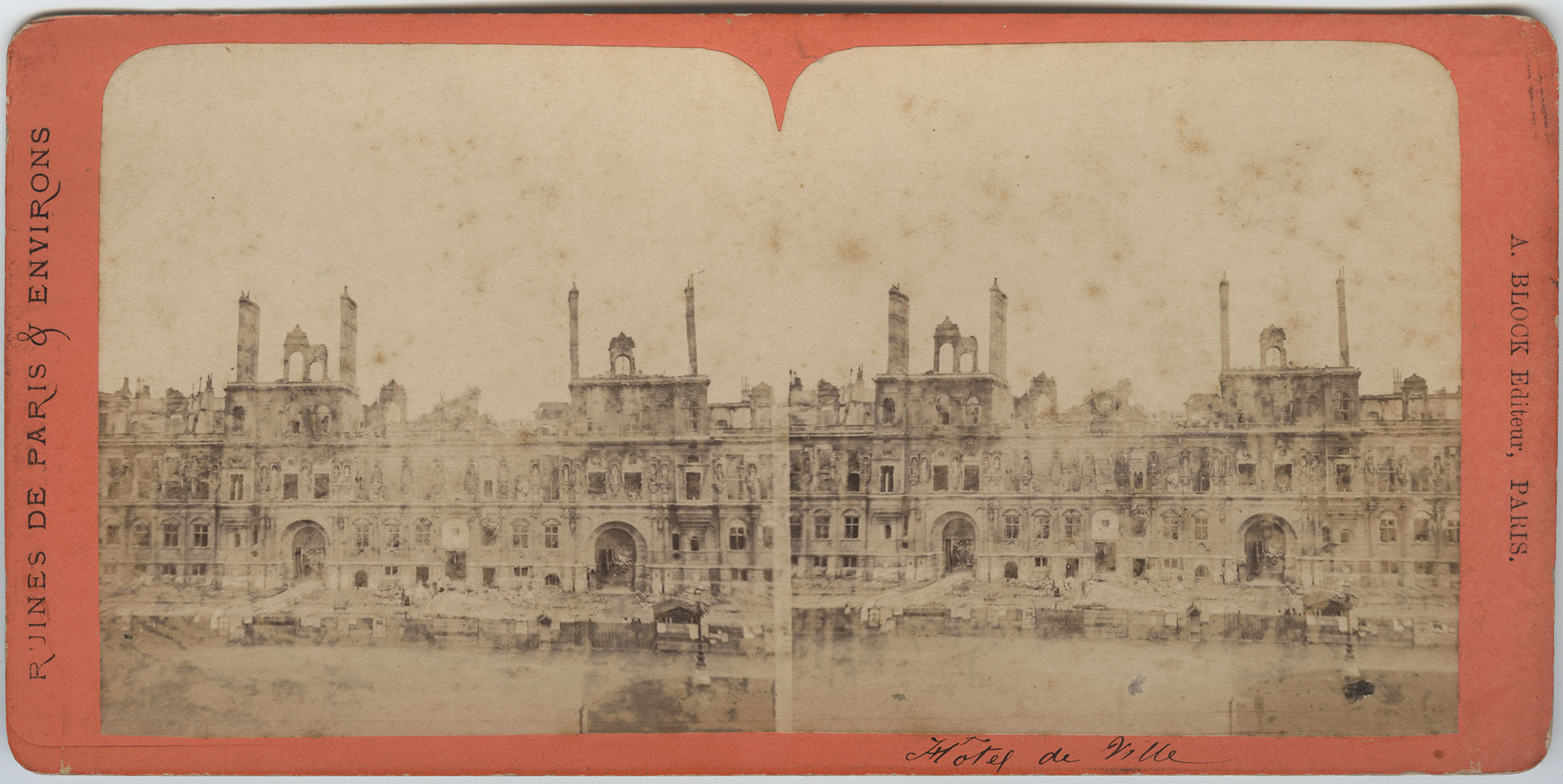
Burnt-down town hall. Photograph by A. Block. 1871.
FBS Foundation
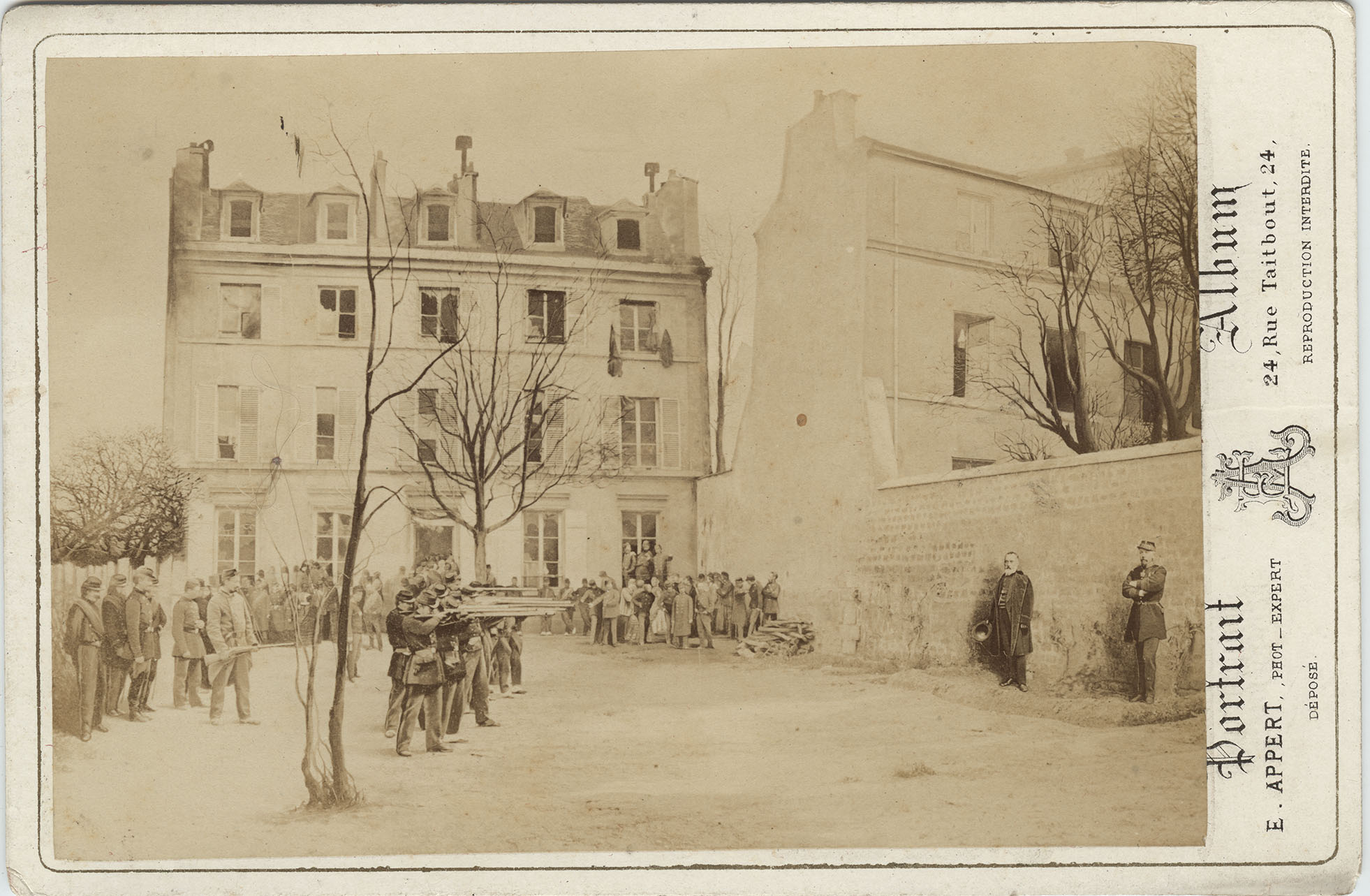
Photomontage of the execution of Generals Clément Thomas and Jules Lecomte, by Ernest Eugène Appert. 1871.
FBS Foundation
These pieces, in addition to recording crucial events, reflect photography’s capacity not only to inform, but also to interpret, influence and, at times, distort reality. This dualism between document and artistic creation consolidated photography as an indispensable tool in the telling of historical events.
Among the most innovative visual advances of the period was also the use of early photomontages, a technique that combined the creativity of illustrators and photographers to recreate and manipulate scenes. An example of this practice is the photomontage of the execution of Generals Clément Thomas and Jules Lecomte, produced by Ernest Eugène Appert (1830-1891) in the Montmartre district on 18 March 1871. This image, which depicts the execution of the officers, is now in the FBS Foundation. A copy of this work is also kept in the archives of the Musée de la Préfecture in Paris.
In addition to this and other stereoscopic images, the FBS Foundation holds several historical albums published between 1871 and 1872. These materials constitute a valuable documentary source that provides a better understanding of the context of the period. Among the most outstanding albums is one entitled Les ruines de Paris et ses environs, a unique work that brings together 100 photographs. These images show an unpublished Paris deeply marked by the devastation caused by the effects of the war.
In addition to their documentary value, some photographs served a practical purpose: police identification of insurgents. These images facilitated the subsequent arrest and execution of participants in the Commune. Such was the case with the photographs of the study of Eugène Disdéri (1819-1889), who in May 1871 crudely captured the Communards shot in Versailles, portrayed in their coffins, leaving an indelible mark on the historical memory of the conflict.
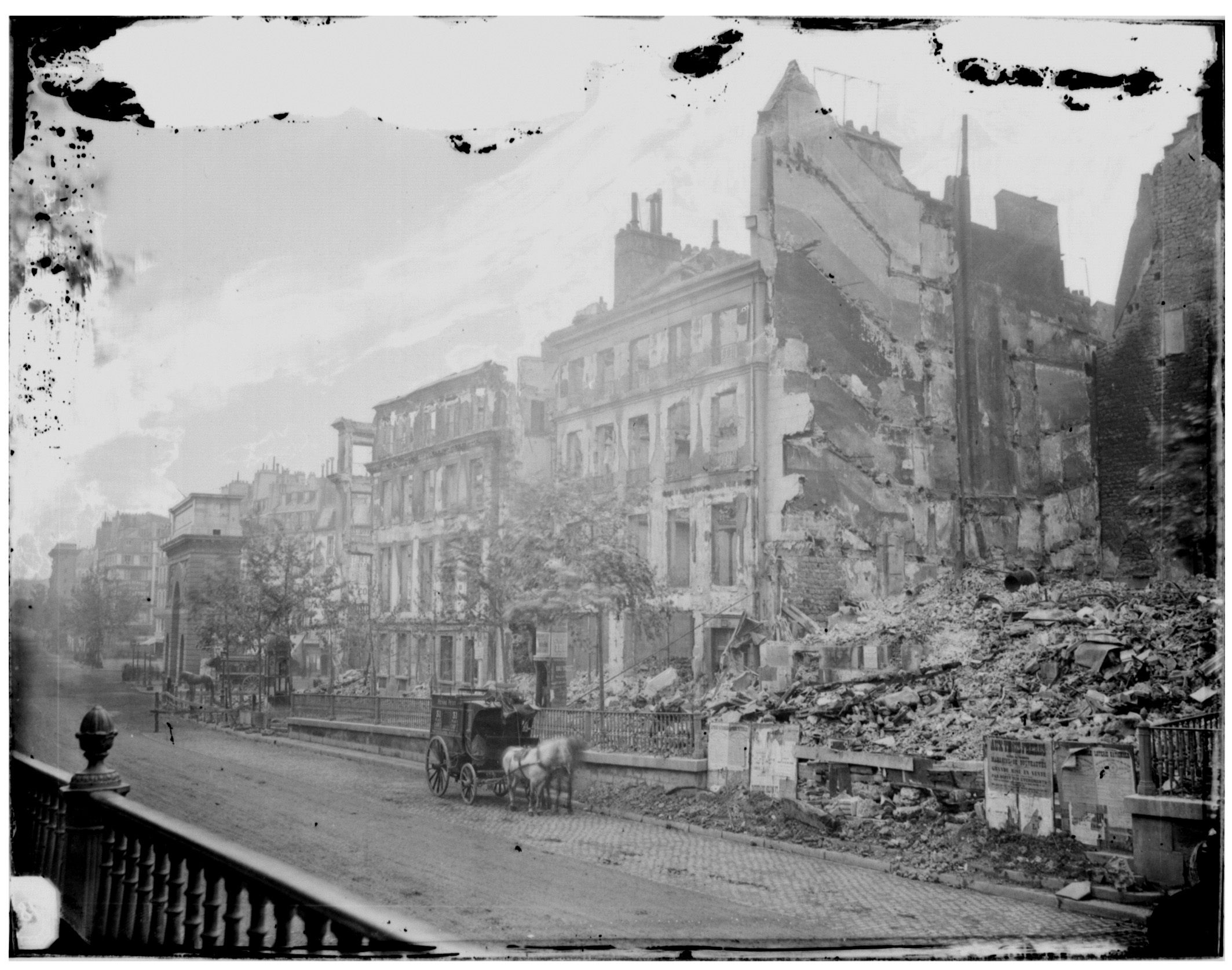
Ruins of Paris. Photograph by Pierre Petit. 1871. Maison Nicéphore Niépce
A prominent name in Commune photography was Pierre Petit (1832-1909), known for his very moving images of empty streets and fire-ravaged buildings. The timelessness of his photographs is echoed in similar scenes taken during later conflicts. This parallel underlines how war photography transcends the ages, bearing witness to human frailty in the face of conflict.
The photographers of this period were called ‘the collodion gunners’ because they all used the same technique, which was dominant at the time. The negatives used were glass plates emulsified with wet collodion.
The importance of photography in the Paris Commune lies not only in its value as a historical record, but also in its role as a political and emotional tool. These images helped to perpetuate the memory of a revolutionary episode which, though brief, had profound repercussions on the history of France and the world.