
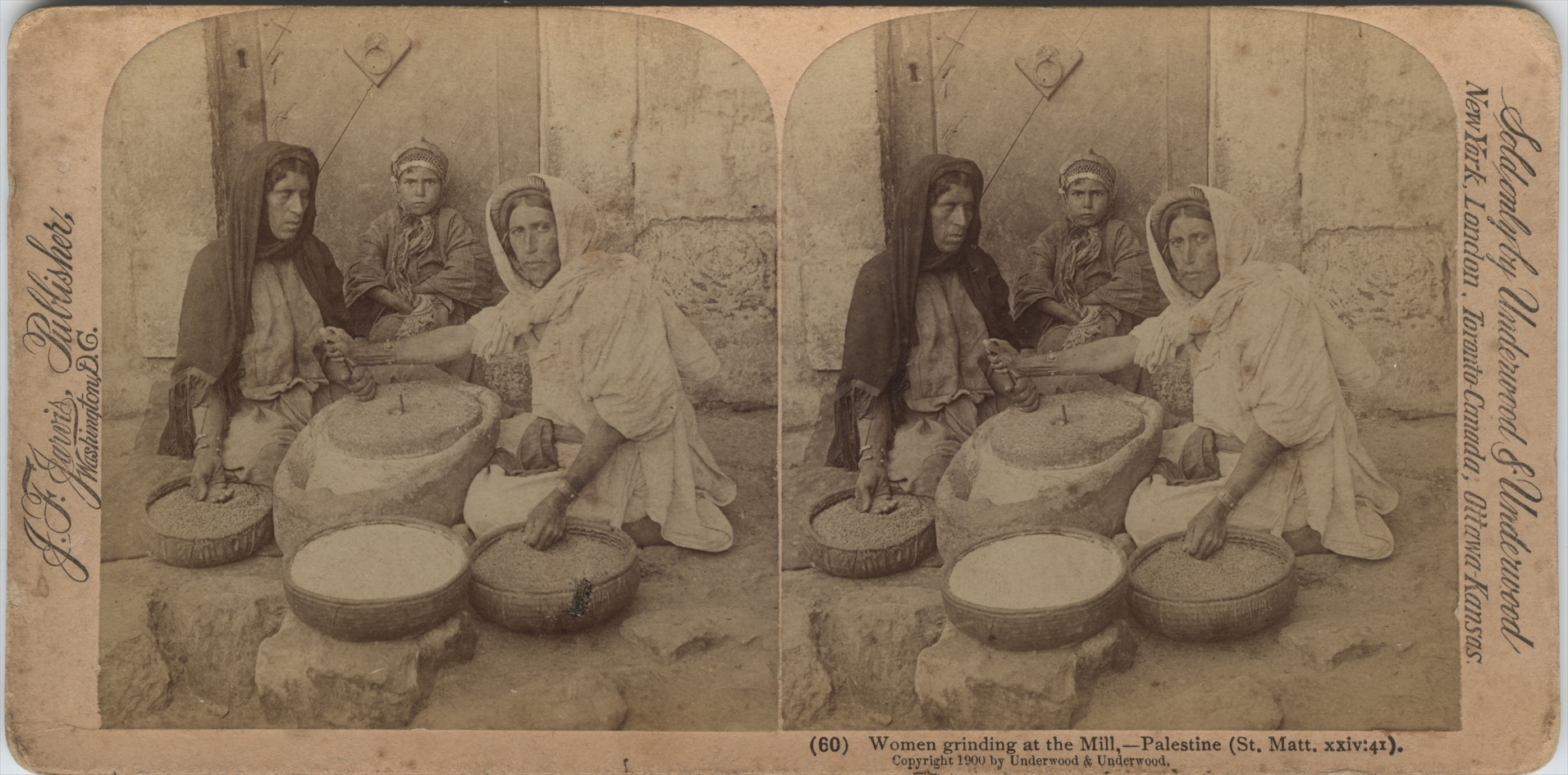
Three Palestinian women grinding grain with a hand mill. J.F. Harvis Publisher. Underwood & Underwood. FBS Foundation Collection
A photograph from the late 19th century, held in the FBS Foundation, shows three Palestinian women grinding grain with a hand mill. Seated on the ground, surrounded by baskets and flour, they depict an everyday scene. However, this image, distributed by the American company Underwood & Underwood and published by J.F. Harvis, goes beyond a simple ethnographic document: it is a visual construction calculated to serve a colonial narrative.
The photograph bears a printed biblical quote that links the scene to Christian imagery : “Two women shall be grinding at the mill; one shall be taken, and the other left.” (Matthew 24:41). These images, mass-produced and sold in Europe and America, reinforced the idea of an East frozen in time—picturesque, yet static.
At the time, Palestine was part of the Ottoman Empire, though it was already attracting growing European interest. Decades later, after World War I, it would come under British control. Images like this one, taken in an Ottoman context, circulated in the West as if they belonged to a land without its own history.
These kinds of representations were not limited to albums or catalogs. In the grand world’s fairs of the 19th century, such as those in Paris (1889) and Chicago (1893), entire pavilions were built to display non-European cultures as if they were part of a living museum. Palestine, although lacking its own pavilion, was represented through photographs, objects, and staged scenes that reduced it to biblical décor. Women grinding grain, stone markets, and traditional clothing were presented as evidence of an authenticity frozen in time.
Today, this photograph invites us to look beyond what it shows. It reminds us how the image of Palestine has been constructed from the outside, and how such representations have contributed to silencing voices, erasing histories, and fixing a foreign narrative. In a present marked by violence and occupation, revisiting these images through a critical lens is also an act of resistance: a way to affirm that Palestine is not only a picturesque past, but also a living present and a future yet to be imagined.