
Harper’s Weekly magazine, 22 July 1865, published an engraved photograph by Alexander Gardner of the hanging of Mary Surratt, Lewis Powell, David Herold and George Atzerodt, who were convicted of conspiring to assassinate President Abraham Lincoln. The image depicts a macabre event that attracted a crowd of spectators, transforming the execution into a sad spectacle. This scene resembles the public executions carried out by guillotine in France during the Revolution or by garrotte in Spain. Today, public executions persist in some countries and, thanks to media such as television and social networks, they are even more widespread.
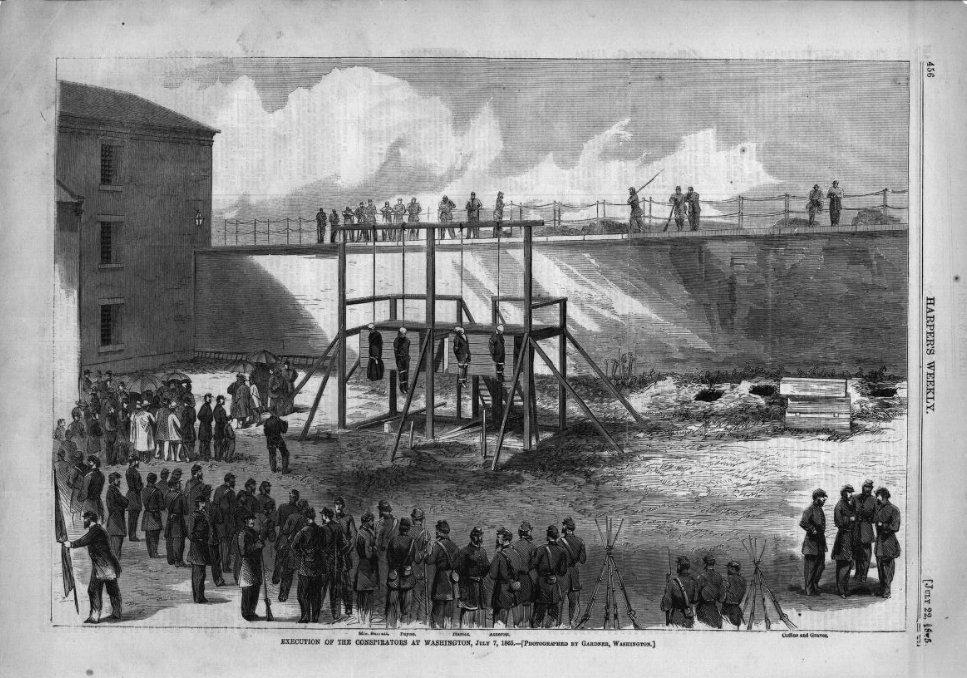
Hanging of Mary Surratt, Lewis Powell, David Herold and George Atzerodt, convicted of conspiring to assassinate President Abraham Lincoln. Harper’s Weekly, July 22, 1865. University of Michigan Library.
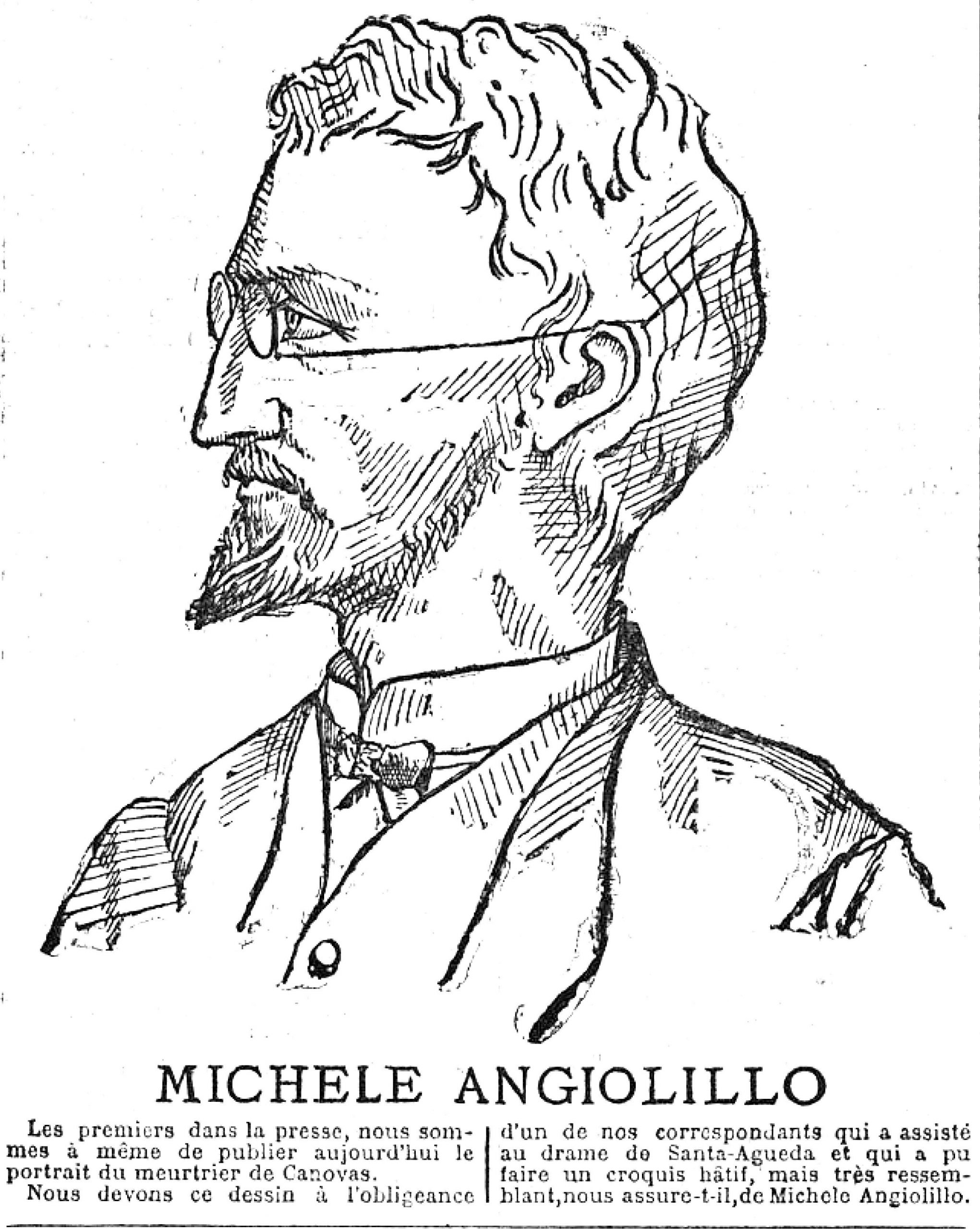
Portrait of Michele Angiolillo published on the front page on August 12, 1897 in the French newspaper L’Intransigeant. Bibliothèque Nationale de France.
On Sunday 8 August 1897, at the Santa Águeda spa in Arrasate, the President of the Spanish Government, Antonio Cánovas del Castillo, was enjoying a few days’ rest. The Italian-born anarchist Michel Angiolillo was also registered at the spa under the false name of Emilio Rinaldini, posing as a correspondent for the Italian newspaper Il Popolo. While Cánovas was sitting reading the press, the newspaper La Época, the Italian anarchist Michele Angiolillo approached him and, without warning, fired three shots, causing his death. At the time, approximately thirty policemen and civil guards were providing security for the president at the spa. Angiolillo was arrested on the spot and subsequently subjected to a military trial that condemned him to death. During the trial, Angiolillo argued that his action was justified by the arrests and torture inflicted on anarchist militants, as well as the subsequent execution of some of them and the imprisonment and deportation of others in the so-called Montjuïc Trials, where more than 400 people were arrested [1]. There was an international campaign against the trial because of the torture and ill-treatment received by the detainees, supported by writers such as Miguel de Unamuno, José Martínez Ruiz (Azorín), Pío Baroja and Ramiro de Maeztu [2].
On 20 August of the same year, Michele Angiolillo was brutally executed by garrotte in Bergara prison, in the province of Gipuzkoa. Before his last breath, Angiolillo raised his voice with a cry for freedom “Germinal!” The series of photographs documenting this moment is shocking and unforgettable; it shows the executioner in the act of executing his victim, while members of the army look on with indifference. This instrument of torture and execution was used by the Spanish state until 1974. The image accompanying this article is part of a report by the amateur photographer Ubaldo Brunet Goitia (1872-1914), who was 25 years old at the time. Various newspaper articles over the years indicate that the photographs were taken from a window, clandestinely, without the authorities being aware of the photographer’s presence.
We do not know the circumstances in which the photographs were taken. Ubaldo Brunet’s father, José Brunet y Bermingham (1836-1891), was a well-known amateur photographer and industrialist from San Sebastian. His photographs depicted the transformation of the capital of Gipuzkoa, especially in the last quarter of the 19th century. A descendant of a Catalan family, he was one of the promoters of the San Sebastian Tramway Company and the La Esperanza paper mill, among other companies. Ubaldo’s grandfather and great-grandfather were also mayors of Donostia.

Ejecución de Michele Angiolillo el 20 de agosto de 1897 en la cárcel de Bergara. Fotografía de Ubaldo Brunet Goitia. Archivo Real y General de Navarra. 03 Execution of Michele Angiolillo on 20 August 1897 in Bergara prison. Photograph by Ubaldo Brunet Goitia. Royal and General Archive of Navarre.
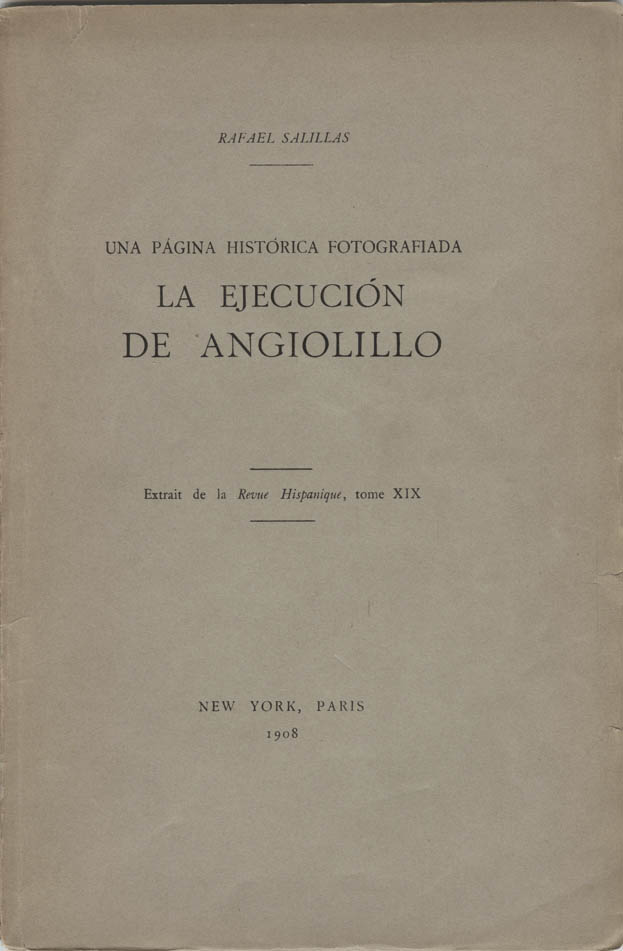
A photographed historical page: “La ejecución de Angiolillo. Rafael Salillas”. New York, Paris, 1908. FBS Foundation Fund.
Among the bibliographic holdings of the FBS Foundation is a publication dated 1908, entitled “Una página histórica fotografiada. La ejecución de Angiolillo”. It was written by the doctor and criminologist belonging to the General Directorate of Prisons, Rafael Salillas (1854-1923). In this work, Salillas analyses the photographs that make up the report, examining in detail every movement of the executioner Gregorio Mayoral, of Michele Angiolillo and of the soldiers guarding him, as well as, once he was dead, the appearance of the doctor who would pronounce him dead. The author describes the moment of execution with an almost perverse coldness, highlighting the rawness and drama that the images capture.
These photographs are not only silent witnesses to historical events, but also act as powerful reminders of the impact that images have on the collective memory. Through photographers such as Ubaldo Brunet Goitia is revealed not only the brutality of certain moments, but also the capacity of photography to immortalise reality, provoking reflection and evoking deep emotions.
Angiolillo’s execution and the dissemination of photographs of his death also highlighted the brutality of the Spanish justice system at the time. The garrotte was a method of execution known for its cruelty.
In short, the story of Michele Angiolillo, and his subsequent execution, captured in images by Ubaldo Brunet Goitia, offer us a window onto the conflicts and tensions of a state in transformation. These photographs not only document a historical event, but also invite us to reflect on the struggles for justice and freedom, and the power of the image to keep collective memory alive.
Juantxo Egaña
______________________________________________________________________________________________________________________________________________________________________________________
[1] El Día, Madrid, 9 de agosto de 1897
[2] “Los escritores españoles ante el proceso de Montjuich”. Rafael Pérez de la Dehesa. Proceedings of the III Congress of the International Association of Hispanists. 1968