
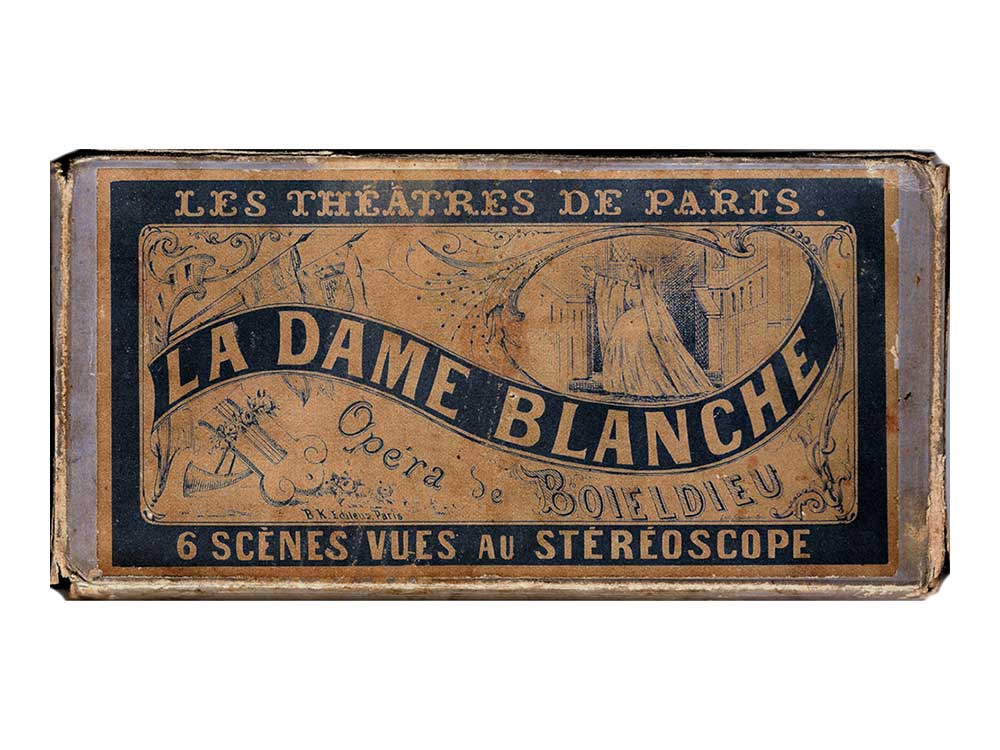
COVER OF THE BOX OF 6 SCENES OF LA DAME BLANCHE
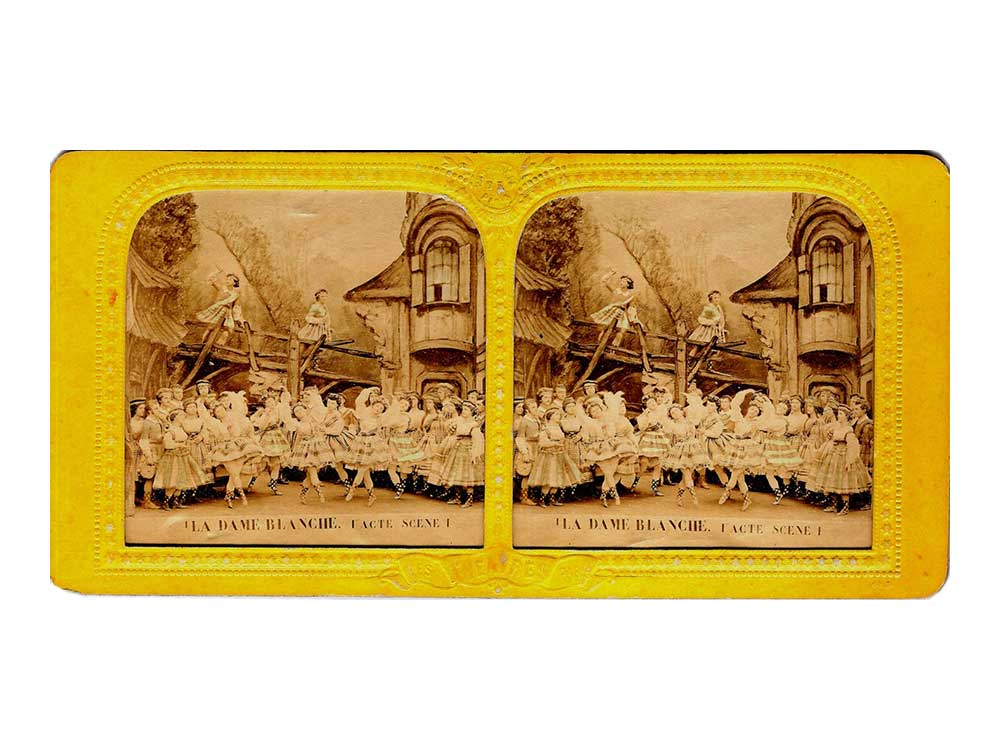
Sonnez, cors et musettes
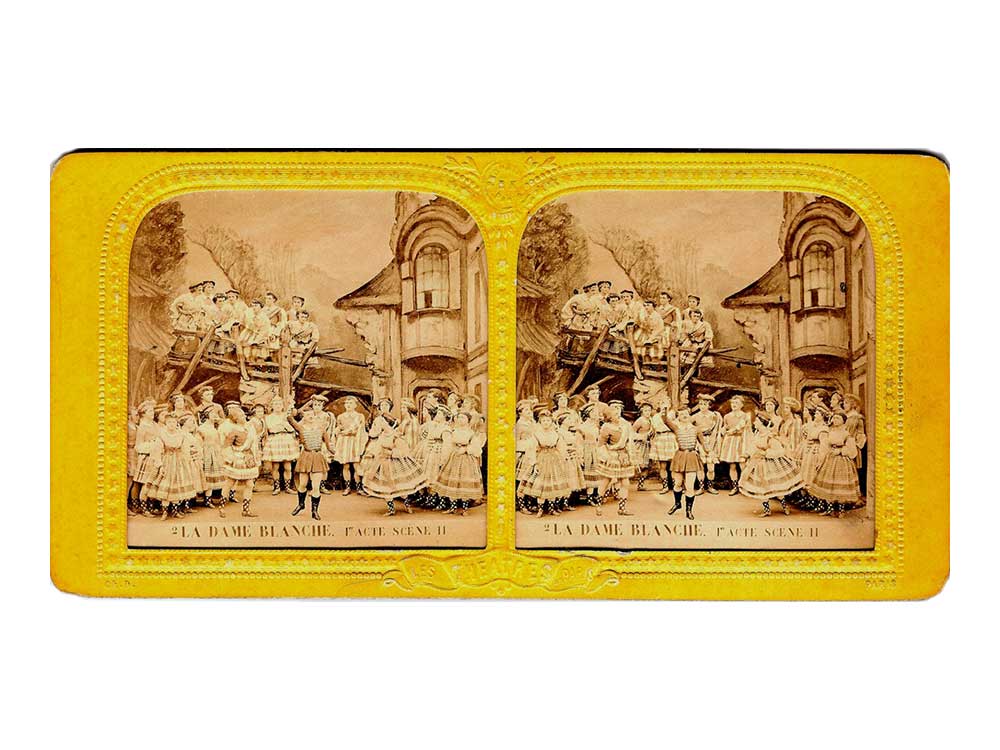
Ah! quel plaisir d'être soldat !
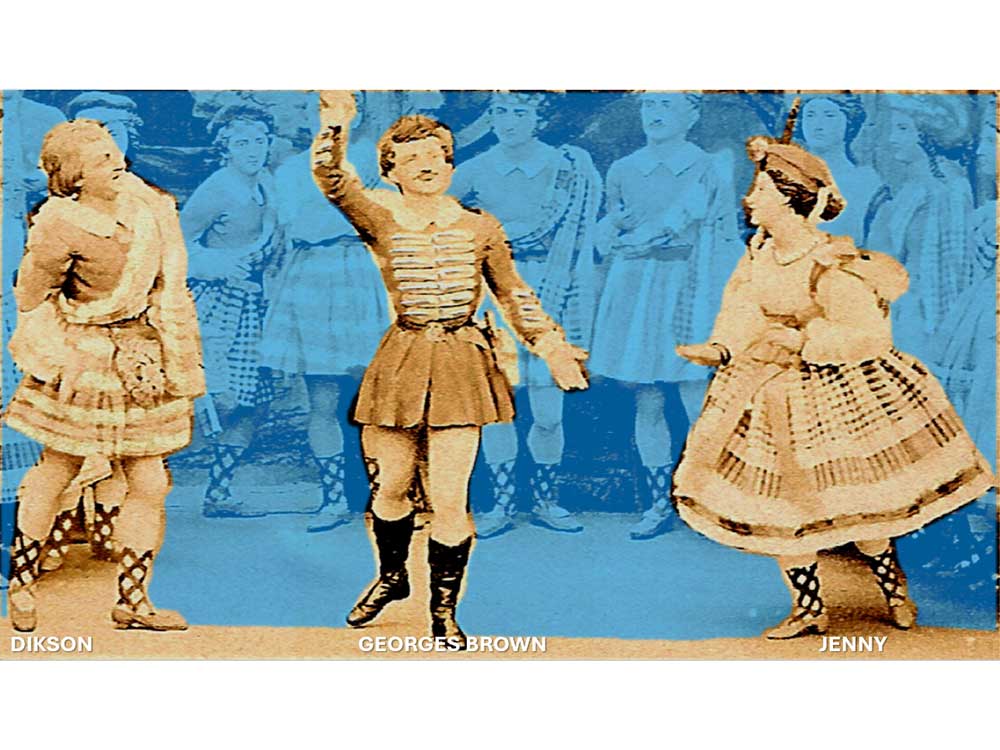
Identification of the personage with the sculpture; in this case Dikson, Georges Brown and Jenny, together with the choir (situated behind.) As shown in the caption.
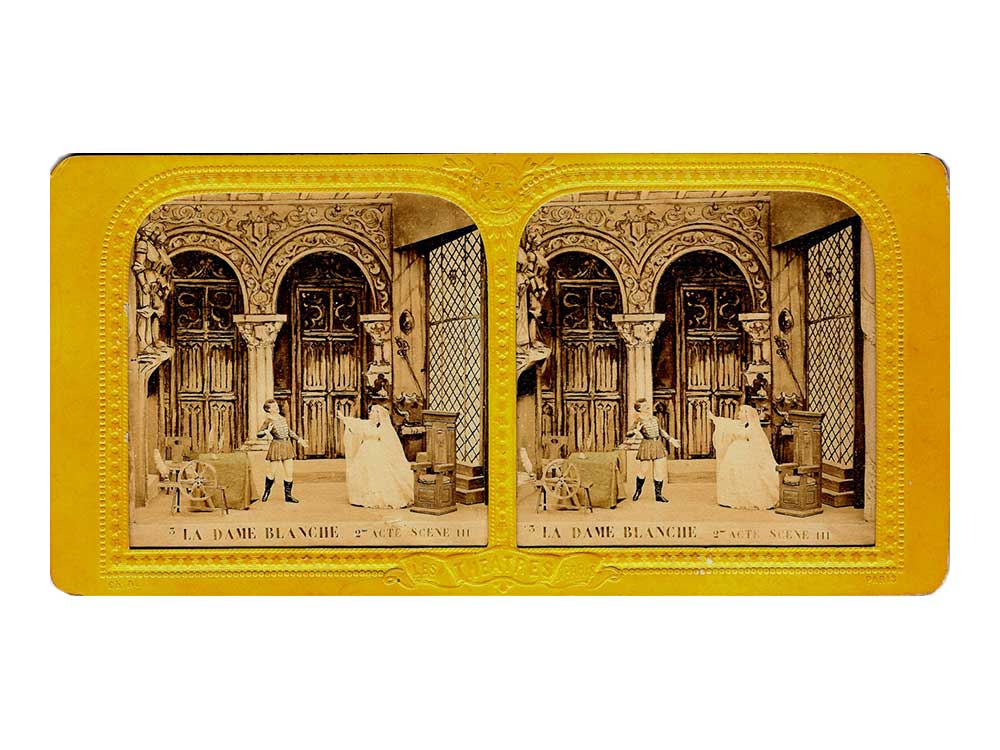
Ce domaine est celui des comtes d'Avenel.
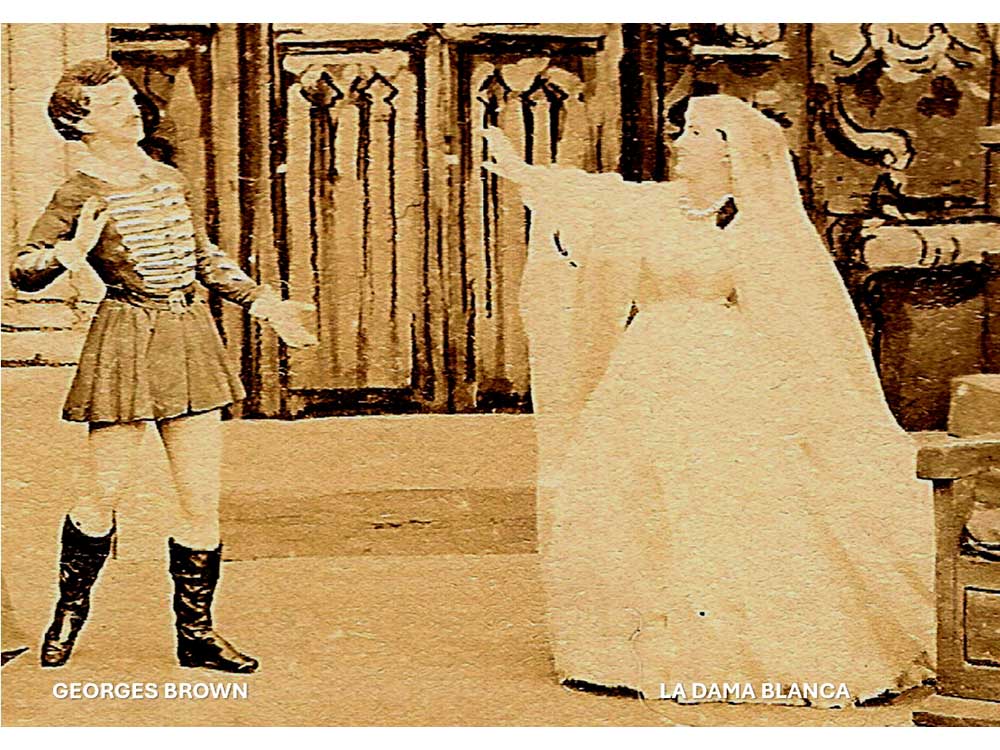
Identification of the character with the sculpture, the duo of Georges Brown and La Dame Blanche.
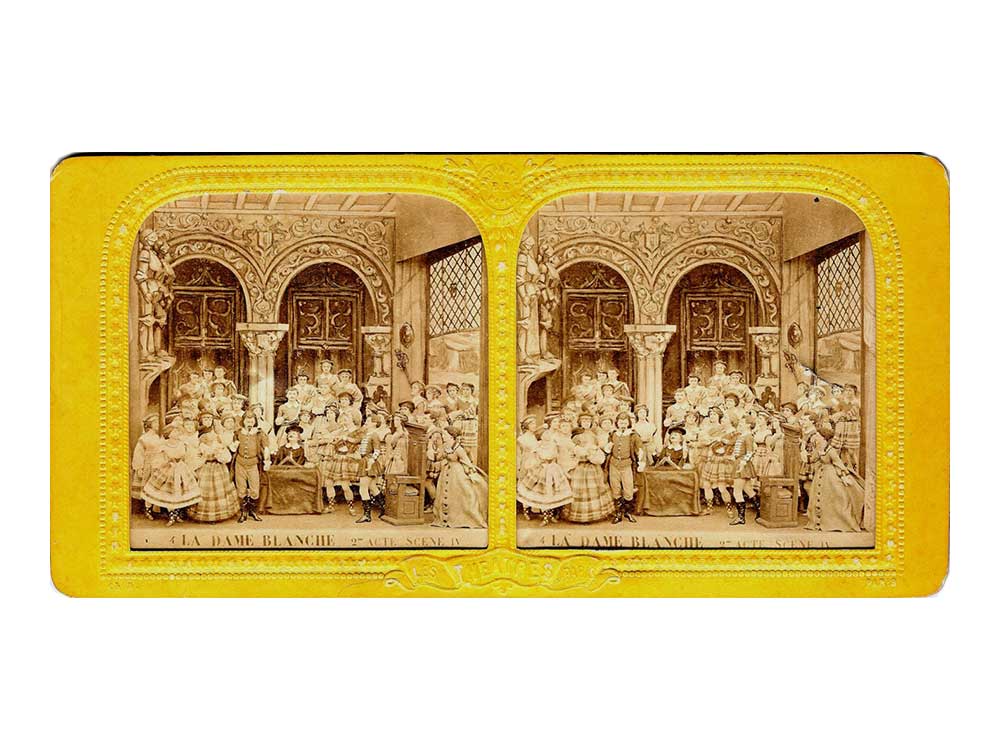
Nous quittons nos travaux.
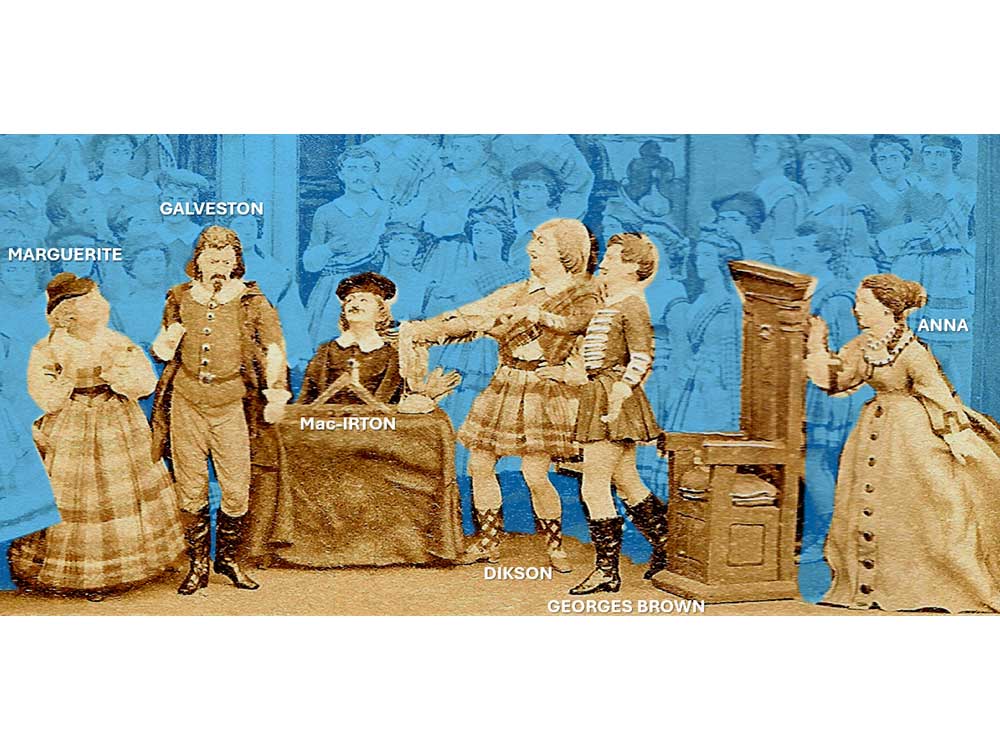
Identification of characters with sculptures, Marguerite, Galveston, Mac-Irton, Dikson, Georges Brown and Anna. In the auction scene.
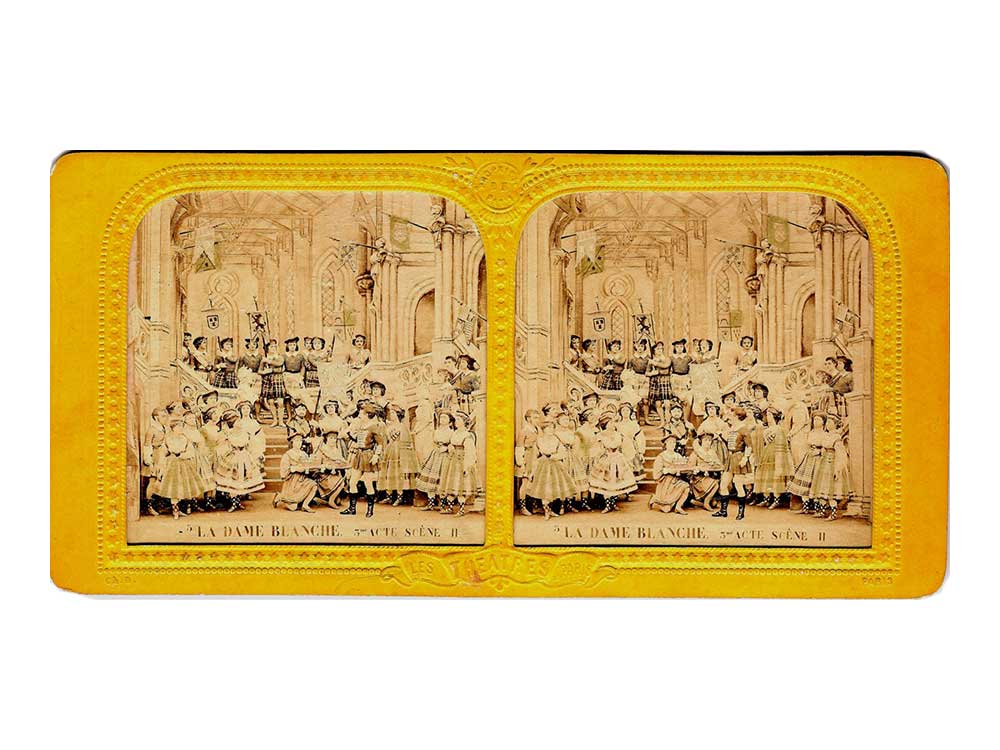
Vive à jamais notre nouveau seigneur.
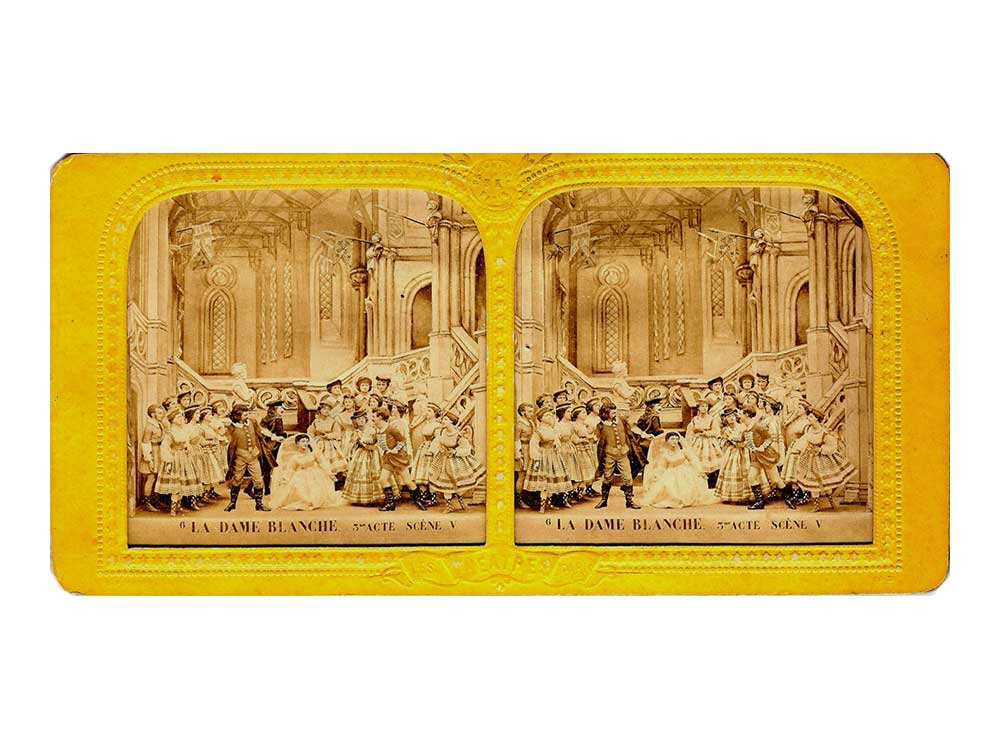
Voici midi, la somme est-elle prete
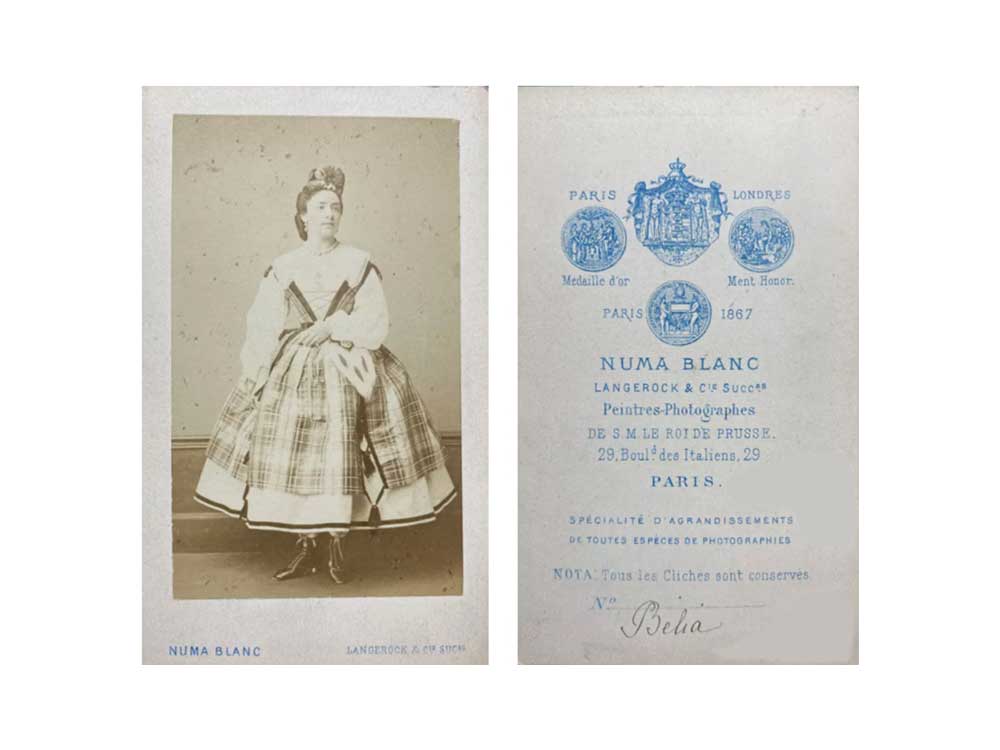
BELIA in the role of Jenny (CV).
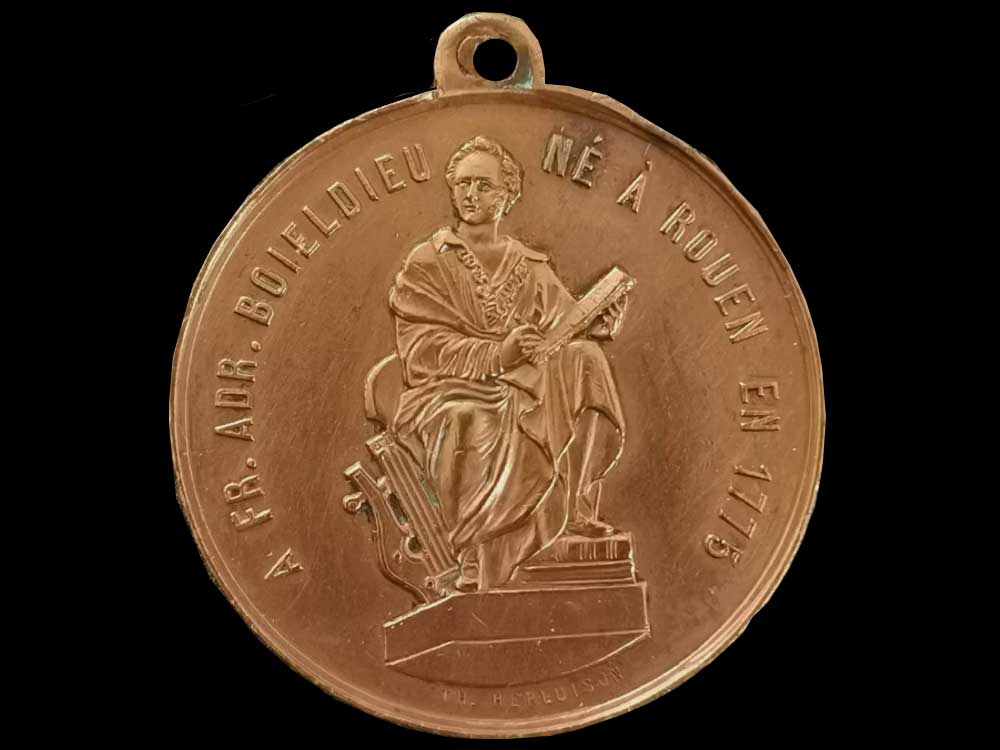
BOÏELDIEU MEDAL.
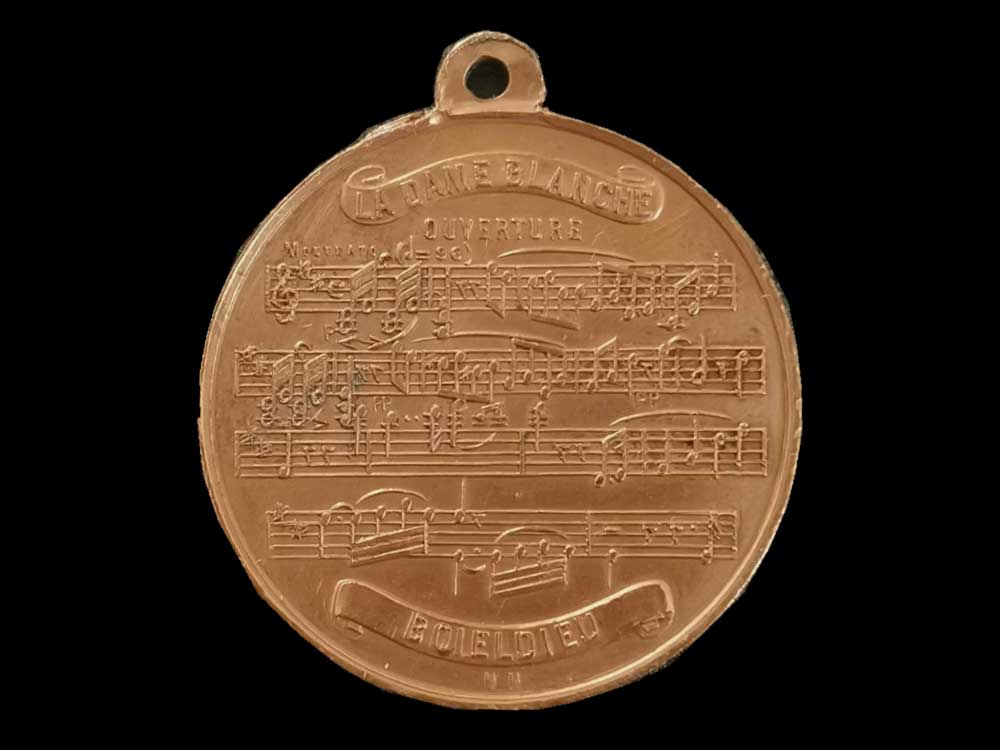
BOÏELDIEU MEDAL, back with the OVERTURE of LA DAME BLANCHE
THE OPERA in historical transmission
LES THEATRES DE PARIS SERIES
LA DAME BLANCHE
Manufacture:
For this month of February/25 we have chosen the comic-opera LA DAME BLANCHE, one of the 15 plays belonging to the 6-scene collectables included in ‘LES THÉÂTRES DE PARIS’, produced by B.K. Editeurs, Paris. The music was composed by the Frenchman François-Adrien Boïeldieu (1775-1834), the librettist being Augustin Eugène Scribe (1791-1861) French playwright, author of many other operatic, theatrical and literary libretti.
Within the FBS Collection, under the generic name of TEATRILLOS, we have some series of stereoscopic groups of French origin, collections of 6 and 12 stereoscopic pairs, developed on different supports, although albumen predominates. Some of them form packages of panoptic images.
In this way, we are once again focusing on the stereoscopic pairs mounted on 9×18 cm format die-cut cardboard, with window openings where the photographic albumen images are located, forming a package of albumen images and tissues that allow the image to be transformed into colour, using a simple backlighting system. The original negatives are usually made of glass; the process used to obtain this negative is wet collodion (1855 to 1895, approximate end).
The photographs summarise, succinctly but literally, themes from all possible categories, including opera (serious, slapstick and comic), ballets, etc. We can see the summaries in images corresponding to: biblical texts, musical librettos, games, tales and legends, etc., originally intended to be verbalised, recited and/or sung, read or seen in engravings and paintings.
Each group of 6 or 12 cards, was supplied in boxes and cases, whose cover, or flap, identified: the work represented, genre, author, name of the collectible (according to the publisher) and the number of scenes that summarised the action. An example of this is the box of La Dame Blanche, shown in image 1.
The plot of the play is set in a county in Scotland in the mid-18th century. Its plot revolves around the possessions and wealth of the Earls of Avenel, the perfidy of their Administrator and Intendant Galveston, who made the heir, Julien Avenel, disappear, discharged his governess Marguerite, and made himself the guardian of the Earls’ ward, Anna, and created intrigue until he appropriated almost all the wealth of the Avenels by plotting the purchase, by auction, of the castle of Avenel and so taking possession of the title of Count, after the death of the true Count, all with the support of the Justice of the Peace, Mac-Irton. (Gothic Romanticism).
The story is set up from the beginning with other characters such as the rich farmer of the village, Dikson and his wife Jenny, who relate the tale of the ghost, known as La Dame Blanche who guards the ancient Avenel castle. The English officer Georges Brown, who travels through Scotland searching for the young woman who saved and cared for him when he was wounded in battle, his unknown beloved. Gabriel, the farmer’s servant, closes the circle, and a Chorus made up of all the villagers and peasants of the Scottish countryside.
In order to verify the contents of the 6 stereoscopic pairs (panopticons) of the box of ‘LES THÉÂTRES DE PARIS’ we have taken as a model the performance which took place on 04/10/1862 at the Théâtre de l’Opéra-Comique in Paris. The play, in three acts, as far as the stereoscopic cards are concerned, unfolds as follows:
Read more
“Act I.- The scene represents a Scottish farm next to a new palace (residence of the Avenels), with a background that open onto a view of trees, rocks and a path that goes down from the mountain to the farm. The characters who introduce the action are the Chorus, Dikson, Jenny, Gabriel and Georges Brown, a hiker who, after identifying himself as an English soldier, solves the problem about sponsorship for the farming couple, in order to be able to baptise their son in an appropriate way.
This First Act has 7 scenes; but the two stereoscopic pairs that summarise it are: Card 1 – the introductory chorus to Scenes I and II, Sonnez, cors et musettes. Card 2 – scene III in which Georges Brown explains who he is, before all the inhabitants of the shire gathered there, and he sings the aria Ah! quel plaisir d’être soldat !
Act II – The scene depicts a large gothic drawing room. On the left, in the foreground, a large fireplace, next to it a distaff for flax and a table, on the right, coats of arms and a large window giving onto the garden, with a commanding chair in the foreground; in the background two arches on capitals and columns, behind them two large doors (inside the Avenel residence). The characters, in order of appearance on stage, are Marguerite, Anna, Galveston and Georges Brown; until scene 9, when all the members of the cast are assembled with the entrance of Dikson, Jenny, the chorus of farmers and vassals, plus the Justice of the Peace Mac-Irton.
This second Act has 9 scenes. The two stereo cards that summarise them are: Card 3 – scene 7, in which Georges and the White Lady meet for the first time, giving rise to the duet Ce domaine est celui des comtes d’Avenel. Card 4 – represents scene 9, showing the confrontation between Galveston and Georges during the auction of the castle of Avenel in front of the whole village, identified with Nous quittons nos travaux.
Act III.- The stage is a gothic vestibule which gives access, by a bifurcated staircase, to a space with wooden trusses full of coats of arms, windows with stained glass and oculi. Side galleries and a half-hidden door in the foreground on the left. Four pedestals crown the base of the staircase, but only three support statues. The figures on stage are all members of the cast.
This third Act has 14 scenes, the last of which includes the Finale. The two stereo cards that summarise them are: Card 5 – picks up scene 3 in which Georges collects the keys to the palace and is recognised as the new Count of Avenel by all the inhabitants of the county, giving rise to the choral ensemble Vive à jamais notre nouveau seigneur. Card 6 – belongs to the 14th and final scene, where the mystery of La Dame Blanche is unravelled, with the chorus Voici midi, la somme est-elle prète?
As a curiosity, if you want to see what were the texts on which this story is based, you can consult the books by Sir Walter Scott: ‘Guy Mannering’ (1815), ‘The Monastery’ (1820) and ‘The Abbot’ (1820), as they were the source of inspiration (with many mimetic identity traits) on which the librettist Eugène Scribe based himself.
François-Adrien Boïeldieu was a transcendental composer in the first half of the 19th century; in particular LA DAME BLANCHE, premiered on Dec. 10, 1825 at the Théâtre National de l’Opéra Comique in Paris, was performed more than 1000 times during the 19th century. In 1826, in his native Rouen, he was awarded the Medal of Talent, and the overture to this work, which can be seen in the photos on the carousel, was also minted on medals.
We speak of CRITICISM, SÁTIRA AND CARNIVALS because in this case the Opera, created in 1825, was paradigmatic for one of Victor Hugo’s political summaries. He was a tireless fighter, chronicler of the excesses and crimes that occurred mainly during the period 1851-1870. One of the periods in which he fought against the elimination of the rights and liberties of the French people, in the face of the repression exercised by Napoleon III, in his progression towards becoming Emperor of all French people, with colonialist and absolutist ideas, provoking an unsustainable social situation.
When the coup d’état perpetrated by Louis Napoleon Bonaparte took place in France on 2 December 1851, prior to the Second Empire (Napoleon III; 1852-1870), Victor Hugo in his ‘Book Two. The Government’; belonging to the work “Napoleon le Petit” takes up the imperial announcement of 14 January 1852, quoting the self-proclaimed emperor, in whom he was inspired for its drafting. The text of Victor Hugo concluded:
……, and which only abolished liberty, has been happily and indisputably inspired to M. Bonaparte by an old advertisement of a provincial theatre, which we copy on this subject:
Big and surprising performance for today
LA DAME BLANCHE
OPERA IN THREE ACTS
The above serves to contextualise these photographs, which were published at a time when voice recordings did not exist, as the first somewhat intelligible ones were made between 1877-78.
The 1862 performance, which has been used for this summary, included scenographies and performances made on card and sculptural groups for the characters (most of them articulated). They thus constituted miniature scenes, reproducing specific parts of the plays. All this took place at a very turbulent time in France’s history. In fact, this opera was censored several times between 1860 and 1870.
Some of the artists who took part in the performance of Oct. 4, 1862 at the Théâtre de l’Opéra Comique in Paris, of whom photographic documents of Nadar, Disdéri and Numa Blanc are preserved, were:
- Cico, Marie – pseudonym of Alexandrine-Louise-Hortense Trotté (1841-1875) in the role of Anna. Soprano. There are photos to identify her.
- Bélia, Mademoiselle – pseudonym of Victorine-Zoe Delau (1832-1899); in the role of Jenny. Soprano. See carte de visite in images of the carousel.
- Revilly, Antoinette (1822-1900). Mezzo-soprano, in the role of Marguerite. We have no further information.
- Berthelier, Jean-François-Philibert (1828-1888). Tenor, his role is unknown; from his career, it can be assumed that he played Georges.
- Barrielle (18..-18.. ; chanteur). No information.
- Achard, Léon (1831-1905). Tenor who made his debut in this work.
To learn more:
- Victor Hugo, Napoleon the Little (Napoléon le Petit -ed. J. Hetzel, 1877), Spanish translation in Editorial Lorenzana, 2nd edition Barcelona, Spain 1969 (pp. 43-44- BOOK TWO. THE GOVERNMENT).
- Victor Hugo, Historia de un crimen (Histoire d’un crime -ed. J. Hetzel, 1877) Vol. 1 and 2, Spanish translation by G. Riesgo Ediciones, Madrid, Spain 1972.
- T.K. Treadwell and William C. Darrah, Stereographers of the world – Vol I – foreign, LThe National Stereoscopic Association, copyrigth 1994, ‘ChD Paris, France 6-7 *(Charles Dauvois)initials and “Depose” tabbed in very small letters on some “BK” and “CHG” and “LL (FPF&S) mounts, found in glass views…”.
- François Boisjoly, Répertoire des Photographers – de XIXE siècle, Paris, Les Editions de l’Amateur, 2009, [p. 45 – Block, Adolphe (1829-1918), p. 145 – Lamiche, Françoise Benjamin (1808-1873)], Lamiche fils, Léon (b. 1833), p. 219 – Numa Blanc (1850) – Numa fils, Emile. Nickname HAERING (1866-1880) – Numa, Georges (1861).
- O. Krakovitch, Censorship of the repertoires of the great Parisian theatres (1835-1906), Inventory (F/18/669-F/18/1016,F/21/966-F/21/995). National Library of France. CENSORSHIP ARCHIVES RELATING TO LA DAME BLANCHE: F/18/696, À Boïeldieu, millième représentation de la ‘Dame Blanche’ (6)……
- Wild and Charlton, La Revue et Gazette musicale de Paris, 12 October 1862. 29th year, No. 41, pp. 331-32.
- Juan José Sánchez and Yolanda Fernández-Barredo, ‘Actos y Escenas de la Dama Blanca’. Transcription of scenes and correlation with the images (in half-pair). Study based on documents from the BnF, BNE, and different sources such as Wikipedia, Kareol.es.htm , ….
- Comic-opera LA DAME BLANCHE – Score for Orchestra – Reconstructed in 1825 by PAUL PUGET
- To see the bio and the photograph of the tenor Léon Achard (1831-1905) follow this link.
- To see the bio and the photo of the tenor-light Jean François Berthelier (1828-1888) follow this link.
- To see the Rennes Comic Opera (2021-2022) – La Dame blanche (The White Lady), Boieldieu (and other performances) follow this link.
- To see the Rennes Comic Opera (2021-2022) – La Dame blanche (The White Lady), Boieldieu follow this link.